
ESG investing, which stands for Environmental, Social, and Governance investing, has emerged as a powerful trend reshaping the global financial landscape. Investors today are more conscientious than ever, seeking portfolios that reflect their ethical values while still aiming for competitive financial returns. This shift reflects broader societal concerns about climate change, social inequality, and corporate accountability.
Rather than focusing solely on short-term profits, ESG investing encourages a more holistic view of corporate performance. It evaluates how companies manage environmental risks, treat employees and communities, and govern themselves internally. This review dives deeper into the concept, examining its core principles, benefits, limitations, and practical implications to help investors assess whether this strategy aligns with their financial objectives.
Why review ESG investing? As its adoption accelerates among institutional and retail investors alike, understanding its nuances is essential for making informed and balanced investment decisions.
Overview of ESG Investing
At its core, ESG investing integrates non-financial factors into traditional financial analysis. Environmental criteria examine how companies address climate risks, energy efficiency, and natural resource use. Social factors assess labor practices, diversity, community engagement, and customer responsibility. Governance criteria focus on leadership structure, transparency, shareholder rights, and ethical conduct.
These factors are increasingly viewed as indicators of long-term stability. Companies that manage ESG risks effectively may be better positioned to adapt to regulatory changes, reputational challenges, and market disruptions. As a result, ESG frameworks are no longer niche tools but central components of modern portfolio construction.
Investors can implement ESG strategies through mutual funds, exchange-traded funds, or direct stock selection. Many funds now apply ESG screens or actively engage with companies to encourage better practices. This flexibility makes ESG investing accessible to a wide range of investors with varying risk tolerances.
Pros and Cons
ESG investing offers a balanced mix of benefits and limitations. While it allows investors to align financial goals with ethical considerations, it also introduces challenges related to measurement, cost, and diversification. The table below summarizes the key advantages and disadvantages to help investors evaluate whether ESG investing fits their strategy.
| Pros | Cons |
|---|---|
| Aligns investments with personal values and ethics | ESG scoring lacks universal standards |
| Potential for strong long-term performance and resilience | Risk of greenwashing by some companies |
| Lower exposure to regulatory and reputational risks | Excluding sectors can limit diversification |
| Growing availability of ESG funds and tools | Higher expense ratios than traditional funds |
In-Depth Analysis of ESG Investing
Performance
Historically, ESG investments have delivered returns that are broadly comparable to traditional portfolios, challenging the assumption that ethical considerations require a financial trade-off. Multiple market studies show that companies with strong ESG practices often demonstrate more stable earnings and lower downside risk during periods of market stress. This resilience is frequently attributed to better risk management, diversified supply chains, and stronger relationships with regulators, employees, and customers.
During periods of volatility, such as economic downturns or regulatory shifts, firms with robust governance and sustainability policies may adapt more quickly. While ESG investing does not guarantee outperformance, it often supports consistency and downside protection, making it appealing for long-term investors focused on risk-adjusted returns rather than short-term gains.
Usability and Accessibility
Access to ESG investing has improved significantly in recent years. Major investment firms and robo-advisors now offer ESG-focused mutual funds, ETFs, and managed portfolios that simplify participation. These platforms reduce the need for individual stock analysis by applying predefined ESG criteria and automated rebalancing.
For experienced investors, advanced screening tools allow customization based on specific environmental, social, or governance priorities. This flexibility enables investors to align portfolios with personal values while maintaining control over asset allocation. As educational resources and transparency improve, ESG investing continues to become more approachable for a broader audience.
Credibility of Metrics
Despite progress, ESG data consistency remains a challenge. Different rating agencies often apply distinct methodologies, leading to varying scores for the same company. These discrepancies can create confusion and complicate investment decisions. Additionally, data availability may vary across regions and industries, limiting comparability.
Regulatory efforts and standardized reporting frameworks are gradually improving reliability. As disclosure requirements expand, ESG metrics are expected to become more transparent, comparable, and actionable for investors.
Long-Term Impact
Beyond financial performance, ESG investing seeks to influence corporate behavior over time. By directing capital toward responsible companies, investors encourage higher standards in sustainability, labor practices, and governance. This market-driven pressure can motivate organizations to improve policies and accountability.
Over the long term, this approach supports systemic change by aligning financial incentives with societal goals. While progress is gradual, ESG investing plays a role in shaping more sustainable and responsible business practices across global markets.
Comparison with Traditional Investing
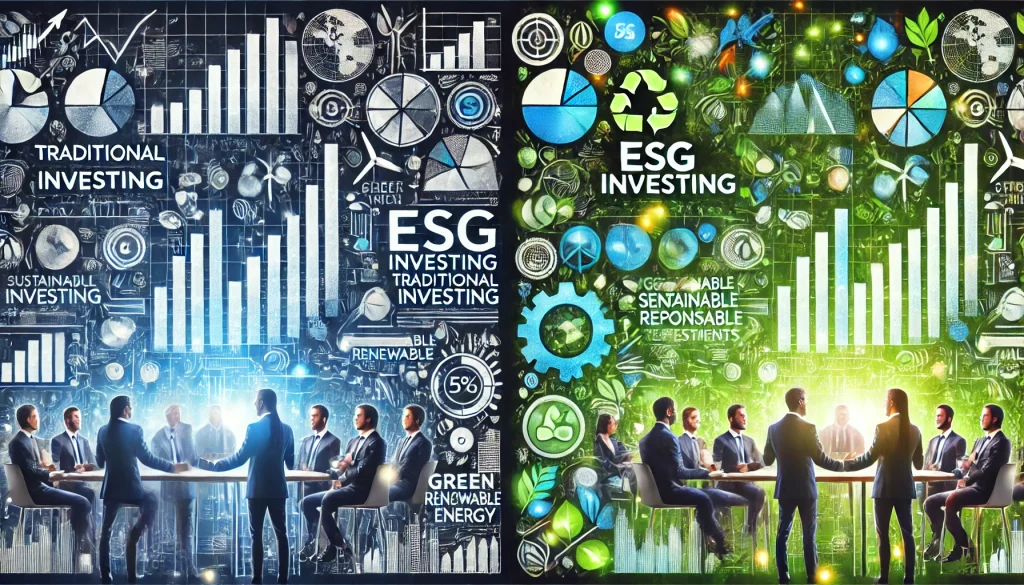
Similarities:
- Both aim to generate returns and build wealth.
- Risk management and portfolio diversification remain central goals.
Differences:
- ESG investing incorporates ethical considerations, while traditional strategies focus purely on financial performance.
- ESG funds may avoid high-yield sectors like oil or coal, which are prominent in traditional portfolios.
While traditional investing offers broad diversification and lower fees, ESG investing appeals to those prioritizing values and sustainability alongside returns.
FAQ
What does ESG stand for in investing?
ESG stands for Environmental, Social, and Governance. These are the criteria used to evaluate a company’s sustainability and ethical impact.
Is it profitable?
Yes, it can be profitable. Companies with strong ESG practices often show resilience and long-term financial performance.
How do I start it?
You can start it by exploring mutual funds, ETFs, or individual stocks with high ESG ratings. Robo-advisors also offer ESG-focused portfolios.
Conclusion
ESG investing represents a transformative approach to financial management, offering a chance to align investments with personal values. While it comes with challenges like higher costs and inconsistent metrics, its long-term benefits—both financial and societal—make it a compelling choice for many.
If you prioritize ethics and sustainability in your investment strategy, ESG investing is worth considering. Just ensure you do your due diligence to avoid greenwashing pitfalls.
ESG Rating: 4.5/5
ESG investing scores high for its innovative approach and alignment with modern values. Minor issues like cost and metric subjectivity hold it back from a perfect score.
Resources:
- Investopedia: What Is ESG Investing?
- Investor.gov: Environmental, Social and Governance Investing
- Finance Alliance: 7 key benefits of ESG investing
- NerdWallet: For Beginners: Environmental, Social and Governance
- ScienceDirect.com: Investing in good and bad times: An international study