
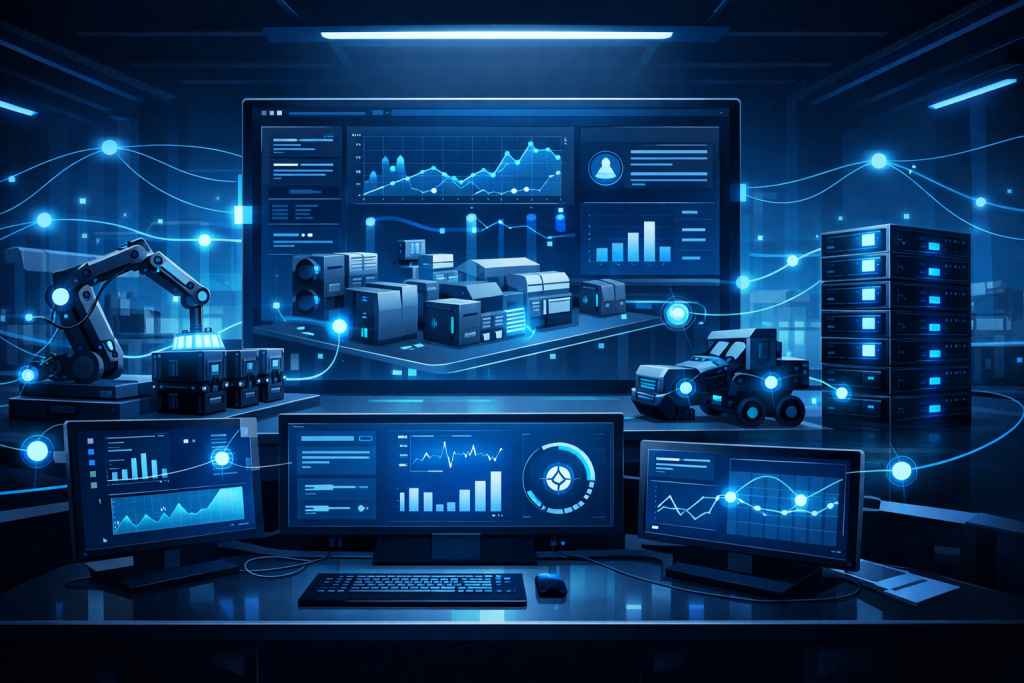
A few years ago, I watched a smart factory demo stall because every sensor reading had to travel all the way to the cloud before anything could happen. It was only a few seconds of delay, but in a live production line, a few seconds feels like forever. That moment made one thing painfully clear: when speed matters, distance matters too. That is exactly why Edge Computing in IoT has become such a big deal in Technology Trends.
At its core, this approach moves data processing closer to where data is created, whether that is on a gateway, a local server, or the device itself. The payoff is hard to ignore: lower latency, faster decisions, stronger resilience, and often better privacy control. For industry professionals, it can improve operations and reduce costly downtime. For tech enthusiasts, it opens the door to smarter homes, connected cars, healthcare monitors, and industrial systems that respond almost instantly. If you want connected systems to feel less clunky and more intelligent, learning how to master Edge Computing in IoT is a smart place to start.
Edge Computing in IoT Materials or Tools Needed
Before you build anything, gather the basics and get your environment ready. You do not need a giant lab or a huge budget to begin. In many cases, a small test setup is enough to understand the workflow. Think of it like cooking a new dish for the first time: you do not start with a banquet. You start with a few solid ingredients and a clear recipe. To work confidently with Edge Computing in IoT, you need connected hardware, a local processing layer, a network, and software that can collect, analyze, and respond to data in near real time.
| Tool or Requirement | Why It Matters |
|---|---|
| Sensors or connected hardware | These generate the raw data your system will use |
| Edge device or gateway | Processes data locally instead of sending everything to the cloud |
| Stable network connection | Supports communication between devices, edge nodes, and cloud services |
| Cloud platform or dashboard | Helps with long-term storage, updates, and centralized visibility |
| Security controls | Protects data, access, and device integrity |
| Test use case | Keeps your setup focused and practical from day one |
Edge Computing in IoT Instructions
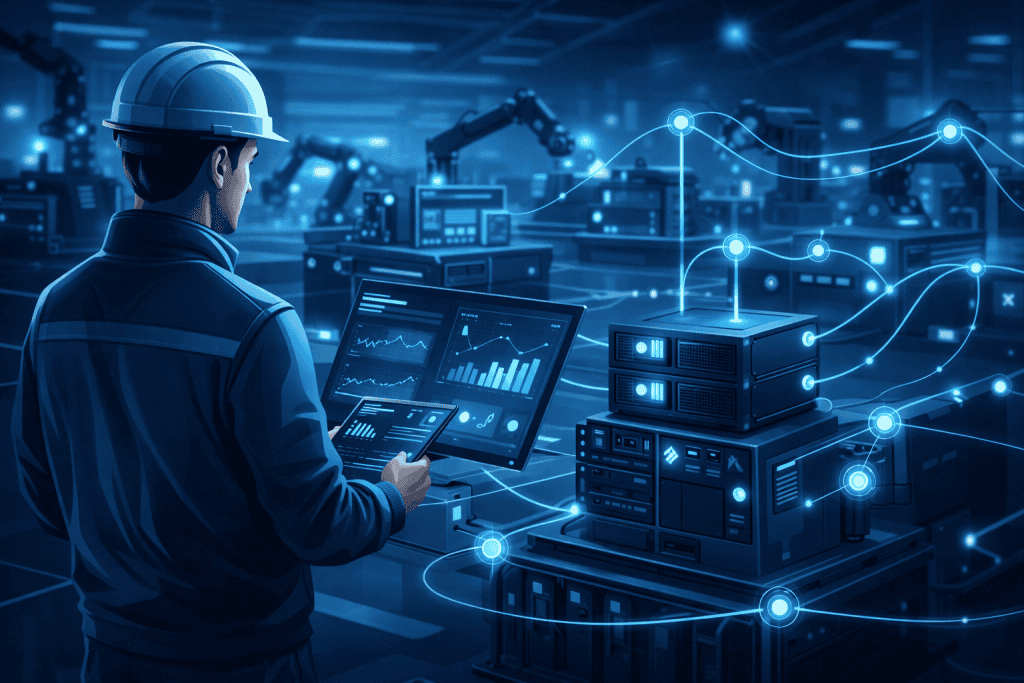
Step 1: Define the problem you want to solve
Start with one practical question. Are you trying to reduce delay in a smart camera feed, improve response time in a factory, or cut bandwidth costs in a remote monitoring setup? A focused goal keeps the project from becoming a tangled mess of parts and dashboards. This is where Edge Computing in IoT becomes more than a buzzword. It becomes a tool with a job. Write down what success looks like, what data needs immediate action, and what can wait for cloud processing later.
Step 2: Choose the right devices and local processing layer
Once the use case is clear, select hardware that fits the workload. Some projects only need lightweight sensors and a compact gateway. Others need more processing power for analytics or video. I once saw a team overspend on hardware because they assumed bigger always meant better. It did not. Their use case was simple temperature monitoring. Match the device to the task. In Edge Computing in IoT, good design often comes from restraint, not excess.
Step 3: Decide what stays at the edge and what goes to the cloud
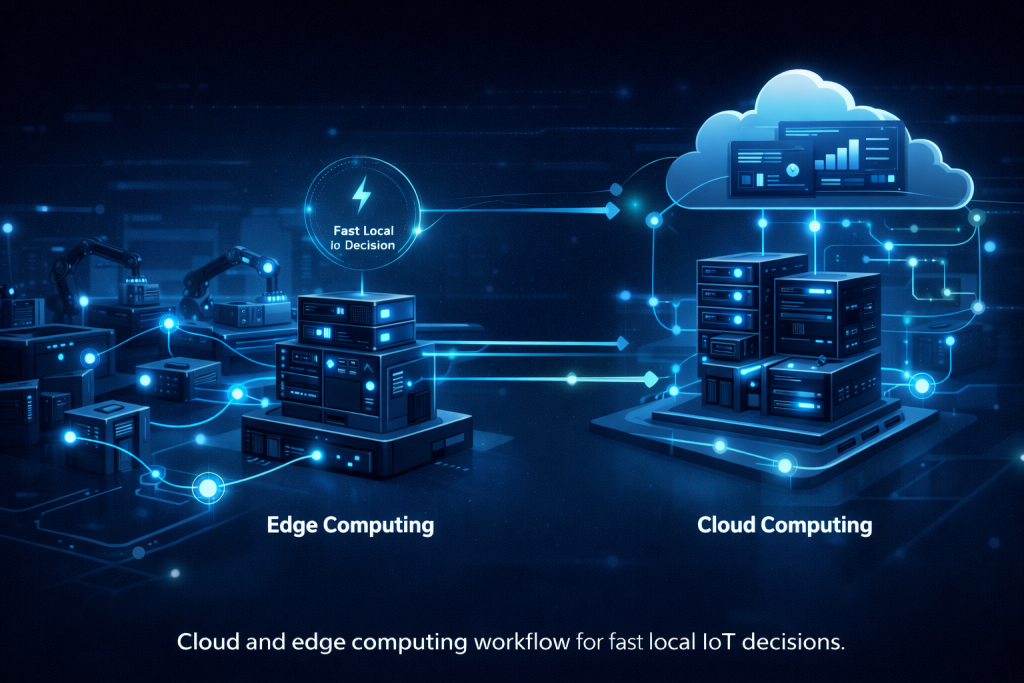
This is where smart architecture makes all the difference. Real-time alerts, filtering, and fast local decisions usually belong at the edge. Historical analysis, model training, and large-scale reporting often make more sense in the cloud. Picture a busy airport. You would not send every tiny decision to a head office three states away. Some calls need to happen right where the action is. That balance is the heart of Edge Computing in IoT, and it helps systems stay fast without losing big-picture visibility.
Step 4: Secure the system from the beginning
Security should never be the thing you bolt on at the end like an afterthought. Protect devices, encrypt communications, control access, and keep firmware updated. Connected environments can become vulnerable quickly when security is ignored. With Edge Computing in IoT, you are often distributing intelligence across many endpoints, so every endpoint matters. A single weak device can become the open window in an otherwise locked house. Build with authentication, monitoring, and patch management in place from the start.
Step 5: Test in a small real-world environment
Resist the urge to deploy everywhere at once. Begin with a pilot project in one room, one floor, one vehicle, or one production zone. Watch how data flows. Measure latency. Notice what breaks when the network drops. This stage teaches lessons no slide deck ever will. In one pilot I followed, the hardware worked beautifully, but dust in the facility kept affecting sensor accuracy. That was not a theory problem. It was a real-life problem. Edge Computing in IoT gets better when tested in the environment where it will actually live.
Step 6: Monitor, adjust, and scale carefully
After the pilot proves useful, refine the setup before expansion. Tune workloads, remove unnecessary data transfers, improve alert logic, and document what worked. This is also the stage where Edge Computing in IoT starts showing its broader value. You may find lower bandwidth usage, faster local action, and more reliable service during outages. Scale in stages, not in leaps. A controlled rollout is easier to secure, manage, and troubleshoot than a rushed deployment built on optimism alone.
Tips and Warnings
There is a temptation to treat edge architecture like magic. Plug in a few devices, add a dashboard, and suddenly everything becomes smarter. Real life is less cinematic. Success comes from simple planning, careful testing, and clear rules about where data should be processed. The most effective teams usually start with a narrow use case, prove the value, and expand from there. That approach saves time, money, and plenty of preventable headaches.
A good rule is to keep immediate decisions local and reserve the cloud for bigger analysis. That keeps systems responsive without losing long-term insight. It also helps you avoid sending mountains of unnecessary data across the network. In conversations about Technology Trends, people often get distracted by shiny terms like futuristic technology, advanced technology, and new inventions. Those ideas are exciting, but the real win usually comes from practical design, steady Innovation, and using iot devices in ways that solve actual problems.
The other big warning is complexity. More devices, more endpoints, and more local processing can mean more things to secure, update, and support. If you do not document your setup and governance rules, maintenance becomes messy fast. Also, do not assume local processing replaces the cloud completely. In most cases, the best systems combine both.
| Tip or Warning | Why It Matters |
|---|---|
| Start with one focused use case | Easier to measure success and fix problems early |
| Process urgent data locally | Improves speed and reduces latency |
| Do not ignore device security | Every connected endpoint can become a weak spot |
| Pilot before scaling | Real environments reveal issues you will not catch on paper |
| Avoid overbuilding | More hardware and features do not always improve outcomes |
| Keep cloud and edge balanced | The strongest systems use each for what it does best |
Conclusion
Mastering Edge Computing in IoT is really about learning where intelligence should live and why. You begin with a clear problem, choose the right hardware, decide what data stays local, build security into the design, test in the real world, and then scale with care. That process may sound technical, but it is also deeply practical. You are simply bringing decisions closer to where they matter most.
As Technology Trends continue to push connected systems into homes, hospitals, factories, and cities, this skill will only become more valuable. The best part is that you do not need to build a massive system on day one. Start small, stay curious, and pay attention to what the data is telling you. Once you see how much smoother and faster a well-designed setup can be, Edge Computing in IoT stops feeling abstract and starts feeling essential.
FAQ
What are the biggest benefits of Edge Computing in IoT for real-time data processing in Technology Trends?
The biggest benefits are speed, reliability, and efficiency. When processing happens closer to the data source, systems can react faster without waiting on round trips to distant cloud servers. That matters in smart manufacturing, healthcare monitoring, autonomous systems, and security applications. In Technology Trends, this approach is especially useful when delays can affect safety, customer experience, or operational performance.
How do beginners start learning Edge Computing in IoT without building a large enterprise system?
The easiest way is to begin with a small pilot. Pick one sensor-based use case, add a gateway or local processing device, and define what should happen instantly versus what can be stored for later analysis. You do not need a giant budget. What you need is a clear objective, a manageable environment, and patience during testing. This helps you understand the architecture before moving into larger Technology Trends deployments.
Is Edge Computing in IoT better than cloud computing for smart devices and connected environments?
It is usually not a matter of better or worse. It is a matter of fit. Edge Computing in IoT is excellent for low-latency responses, local filtering, and resilience during network interruptions. Cloud computing is still valuable for centralized analytics, large-scale storage, and model training. In most modern Technology Trends strategies, the strongest solution is a hybrid one that uses both edge and cloud in thoughtful ways.
Resources
- IBM. What is edge computing?
- Fortinet. What Is Edge Computing?
- SNUC. What Is Edge Computing Technology?
- IEEE Computer Society. Computer.org
- TechTarget. Edge computing definition