
Picture yourself walking into a local farmers’ market early in the morning. The scent of fresh produce fills the air. Strawberries are piled high on one table, but by noon, the price tags suddenly change—they’ve doubled! Why? The answer lies in the invisible dance of supply and demand, one of the most powerful forces in economics.
It describes how prices rise and fall depending on how much of a good or service is available and how many people want it. It’s a simple idea with massive implications—from the price of your morning coffee to global oil markets. In this post, we’ll explore what it means, how they interact, and why understanding this balance helps explain nearly every financial decision we make.
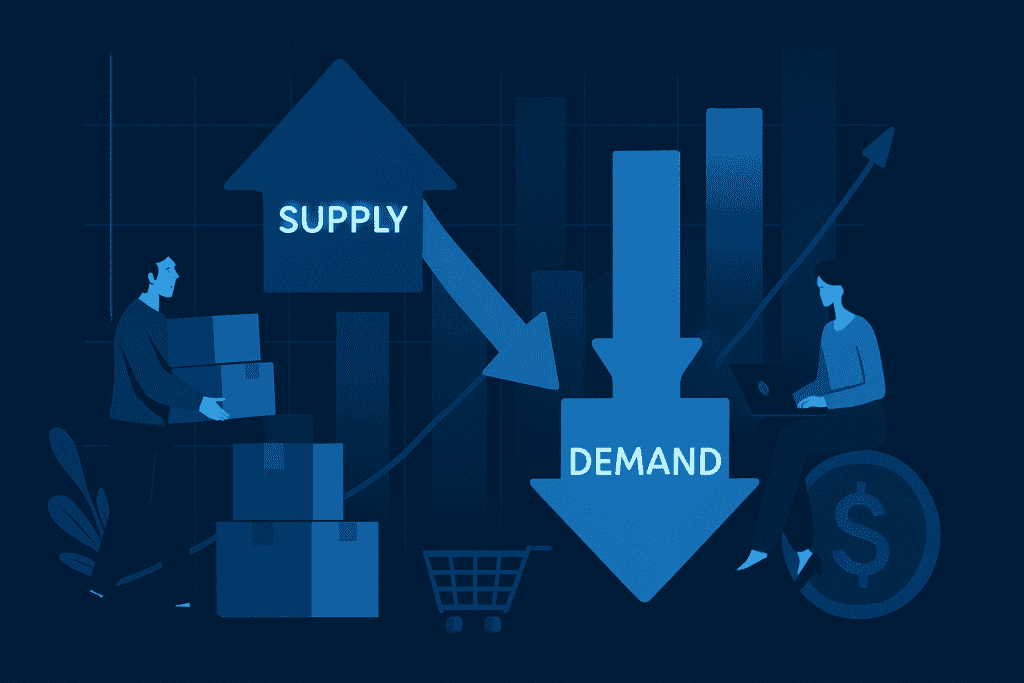
What Is Supply and Demand?
Supply and demand form the foundation of market economics. “Supply” refers to how much of a product or service producers are willing and able to sell at different prices, while “demand” refers to how much consumers are willing and able to buy. The relationship between the two determines prices, production levels, and resource allocation in the economy.
When demand increases and supply remains limited, prices rise. Conversely, if supply grows faster than demand, prices fall. It’s the constant tug-of-war between buyers and sellers that keeps markets dynamic and responsive.
In simple terms:
- Supply is how much producers have.
- Demand is how much consumers want.
- Price is where they meet and agree.
Breaking Down Supply and Demand
When we break down supply and demand, several important components stand out that help shape market behavior.
The Law of Demand
As prices rise, consumers buy less; as prices fall, they buy more. Think of it like shopping during a sale—when prices drop, demand surges.
The Law of Supply
Producers want to sell more when prices go up because higher prices bring higher profits. When prices fall, production often slows down.
Market Equilibrium
occurs where supply meets demand—this is the “sweet spot” where the quantity supplied equals the quantity demanded. It’s the price at which both buyers and sellers are satisfied.
Shortages and Surpluses
When prices are too low, demand exceeds supply, creating a shortage. When prices are too high, supply exceeds demand, creating a surplus. Markets naturally move toward equilibrium to fix these imbalances.
Shifts in Supply and Demand
External factors like weather, technology, and consumer preferences can shift the curves. For example, a new smartphone model increases demand, while a drought can reduce supply of crops.
History of Supply and Demand
The idea of supply and demand has evolved over centuries and shaped how we understand economics today.
| Era / Period | Development | Notes / Importance |
|---|---|---|
| 17th–18th century | Early market theories by John Locke and Richard Cantillon | Introduced concepts of price, value, and scarcity |
| 1776 | Adam Smith’s The Wealth of Nations | Established early principles of free markets and competition |
| 19th century | Alfred Marshall formalized supply and demand curves | Provided mathematical models for equilibrium |
| 20th century | Keynesian and Neoclassical theories expanded analysis | Connected supply-demand to employment and national output |
| 21st century | Digital markets and AI-driven pricing models | Technology transformed how supply and demand interact globally |
From barter economies to algorithmic trading, the concept of supply and demand remains at the heart of economic systems worldwide.
Types of Supply and Demand
Different markets behave differently, and economists categorize supply and demand into several types to better understand these variations.
Individual Demand and Supply
Refers to the behavior of a single consumer or producer. For example, your decision to buy one pizza or two based on its price.
Market Demand and Supply
Combines all individual consumers and producers. It represents the total quantity demanded or supplied at each price level.
Joint Demand
Occurs when two products are used together—like cars and gasoline. A rise in car demand increases demand for fuel too.
Composite Demand
Happens when one product has multiple uses—like milk for drinking or making cheese.
Derived Demand
Refers to demand for inputs based on the demand for the final product. For example, demand for steel depends on demand for cars.
Short-Term vs Long-Term Supply
In the short term, supply might be limited (like crops that take months to grow), while in the long term, producers can adjust output levels.

How Does Supply and Demand Work?
Let’s imagine a simple example: a new gaming console launches. Initially, only a few units are available, but thousands of gamers want one. Because demand is high and supply is low, prices skyrocket. Over time, manufacturers increase production, meeting the demand, and prices stabilize.
This process—where supply responds to demand—happens constantly across every market. Producers analyze trends, consumers adjust their preferences, and equilibrium shifts over time. Governments and businesses use supply and demand models to predict shortages, control inflation, and make policy decisions.
At its heart, the principle ensures that resources flow to where they’re most valued, creating efficiency in the economy.
Pros & Cons
Here’s a quick look at the benefits and challenges of relying on supply and demand in economic systems:
| Pros | Cons |
|---|---|
| Encourages efficient resource allocation | Can cause inequality in access to goods |
| Promotes innovation and competition | Price volatility during crises |
| Reflects consumer preferences accurately | Externalities like pollution not included |
| Self-regulating market mechanism | May fail in monopolies or limited competition |
| Responds quickly to global changes | Can’t always ensure fairness or stability |
Uses of Supply and Demand
The concept of supply and demand extends far beyond textbooks—it powers decision-making in every corner of the economy.
In Business
Companies use supply and demand forecasts to set prices, plan inventory, and adjust production levels. For instance, during high demand seasons, businesses often increase supply to maximize profits.
In Agriculture
Farmers monitor supply and demand trends to decide what to grow. Oversupply leads to lower prices, while shortages can cause food inflation.
In Finance
Stock markets run on supply and demand—prices fluctuate based on investor interest and the number of shares available.
In Technology
Gadget manufacturers track supply and demand data to predict product lifecycles and manage component sourcing efficiently.
In Energy Markets
Oil, gas, and renewable energy industries depend heavily on supply and demand to set prices and plan distribution globally.
In Labor Markets
Wages are determined by the demand for skills and the supply of workers. High-demand fields like AI and cybersecurity see higher salaries.
Resources
- Investopedia. Supply and Demand Definition and Examples.
- Khan Academy. Introduction to Supply and Demand.
- Economics Online. Supply and Demand Explained.
- The Balance. How Supply and Demand Determine Prices.
- U.S. Bureau of Labor Statistics. Understanding Supply, Demand, and Labor Markets.