
Imagine you’re negotiating the price of a used car. You don’t know what the seller will accept, and they don’t know what you’re willing to pay. Each of you must predict the other’s decision to make the best move. That mental dance—trying to anticipate what someone else will do—is exactly what game theory studies.
In the world of economics, game theory helps explain how individuals, businesses, and even nations make strategic decisions when their outcomes depend on the actions of others. Whether it’s companies setting prices, countries forming trade alliances, or investors choosing when to buy or sell, game theory provides a mathematical framework for understanding the logic of competition and cooperation.
It’s more than just a theory; it’s a blueprint for human interaction in complex systems. By studying it, economists and strategists can predict behaviors, design better policies, and make smarter business moves in an uncertain and competitive world.
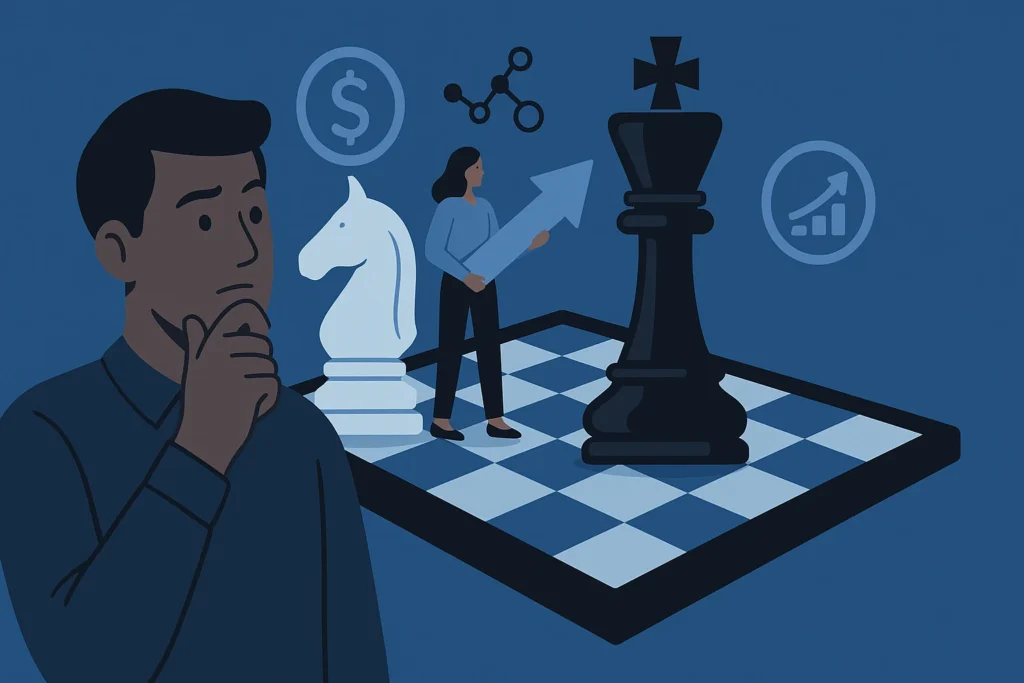
What Is Game Theory?
At its core, it is the study of strategic decision-making. It analyzes how individuals or groups (called “players”) make choices in situations where the outcome depends on everyone’s decisions. The “game” represents any scenario involving conflict, cooperation, or competition—ranging from market negotiations to political elections.
The concept originated in mathematics but has become one of the most powerful tools in economics. It helps answer questions like: How do firms decide whether to compete or collaborate? How do consumers behave when prices change? And how can policymakers encourage cooperation in a global economy?
It models these interactions by assigning payoffs to possible choices. Players choose strategies that maximize their payoffs while anticipating the decisions of others. The result is a systematic approach to understanding human behavior when interests overlap or clash.
Breaking Down Game Theory
When we peel back the layers of what makes it such a crucial part of economics, several key components stand out.
Players
These are the decision-makers in any game—individuals, companies, governments, or even entire markets. Each player’s goal is to achieve the best possible outcome based on available choices.
Strategies
A strategy is the plan of action a player takes to achieve their desired result. For example, in business, a strategy could involve setting prices, entering a new market, or launching an advertising campaign.
Payoffs
The payoff represents the outcome or reward a player receives from a specific combination of choices. In economics, payoffs can be profits, market share, or other measurable gains.
Information
Information determines how much players know about each other’s actions and payoffs. In perfect information games (like chess), everyone knows all possible moves. In imperfect information games (like poker), some elements remain hidden.
Equilibrium
Equilibrium occurs when no player can improve their outcome by changing strategy while others keep theirs unchanged. The most famous version is the Nash Equilibrium, developed by mathematician John Nash, where each player’s decision is optimal given the decisions of others.
Types of Games
Games can be cooperative or non-cooperative, simultaneous or sequential, zero-sum or variable-sum. Each type reveals unique patterns of behavior and decision-making that reflect real-world economic situations.
History of Game Theory
The roots of game theory go back centuries, but its modern foundation emerged in the 20th century.
| Era / Period | Development | Notes / Importance |
|---|---|---|
| 18th–19th century | Early strategic concepts in economics and military planning | Introduced by figures like Daniel Bernoulli and Antoine Cournot |
| 1944 | John von Neumann and Oskar Morgenstern publish Theory of Games and Economic Behavior | Established the mathematical framework for game theory |
| 1950s | John Nash develops the Nash Equilibrium | Revolutionized understanding of rational decision-making |
| 1970s–1990s | Applications expand to politics, biology, and psychology | Game theory becomes interdisciplinary |
| 21st century | Used in AI, finance, and global policy | Becomes central to modern economics and decision science |
From boardrooms to battlefields, game theory has evolved into a universal language of strategy. It explains not just how people compete but how they cooperate to achieve mutual benefits.
Types of Game Theory
Game theory encompasses multiple frameworks that economists use to analyze strategic interactions.
Cooperative Game Theory
In this model, players form coalitions to achieve shared goals and divide rewards. It’s used to analyze alliances, mergers, and partnerships in economics and politics.
Non-Cooperative Game Theory
Here, players act independently, focusing on maximizing personal gain rather than collective benefit. It’s often used in analyzing market competition, negotiations, and pricing wars.
Zero-Sum Games
A zero-sum game is one where one player’s gain is another’s loss. Classic examples include poker and certain market rivalries, where resources are limited and competition is direct.
Non-Zero-Sum Games
In these situations, players can benefit simultaneously through cooperation or mutual compromise. International trade and joint ventures are real-world examples.
Sequential Games
Players make moves one after another, with each observing prior actions before deciding. This model is common in negotiations and long-term investment strategies.
Simultaneous Games
Players act at the same time without knowing others’ choices—similar to firms setting prices simultaneously in competitive markets.
Repeated Games
These occur when the same players interact multiple times, creating incentives for reputation building and long-term cooperation. Repeated games explain why businesses maintain ethical behavior over time.

How Does Game Theory Work?
Imagine two companies—AlphaTech and BetaCorp—competing in the same market. Each can either lower prices or keep them stable. If both lower prices, profits fall. If one lowers and the other doesn’t, the lower-priced company gains market share. If both keep prices stable, both benefit moderately.
Through game theory, economists analyze this “game” by creating a payoff matrix showing outcomes for every decision combination. Each company must predict the other’s move to choose the best strategy. The point where neither can benefit by changing strategy alone is the Nash Equilibrium.
This approach extends beyond businesses. Governments use it to forecast the outcomes of trade deals, environmental agreements, or even military decisions. Investors use it to predict market behavior, while tech companies apply it to AI algorithms that adapt to competitive environments.
Ultimately, game theory provides a structured way to anticipate outcomes, balance risk, and optimize strategies in complex systems.
Pros & Cons
Understanding game theory offers both valuable insights and notable limitations.
| Pros | Cons |
|---|---|
| Helps predict competitive and cooperative behaviors | Assumes all players act rationally, which isn’t always true |
| Improves negotiation and pricing strategies | Simplifies complex human motivations |
| Encourages efficient resource allocation | Outcomes can change with incomplete information |
| Useful in policymaking and global trade | Difficult to apply in large, unpredictable systems |
| Supports AI and behavioral modeling | Requires accurate data for meaningful results |
Uses of Game Theory
The applications of game theory extend far beyond the classroom. It’s a cornerstone of modern economic analysis and strategic planning.
In Business and Economics
Companies use game theory to analyze competition, set prices, and plan mergers or acquisitions. It helps predict how competitors will react to changes in strategy, like product launches or discounts.
In Finance and Investment
Investors apply game theory to forecast market movements and design trading strategies. It’s especially useful in analyzing speculative behavior and reactions to policy changes.
In Politics and International Relations
Governments and organizations use game theory to guide diplomacy, defense strategy, and treaty negotiations. It models cooperation, deterrence, and conflict resolution among nations.
In Technology and Artificial Intelligence
AI systems employ game theory to simulate interactions between intelligent agents, such as autonomous vehicles or predictive algorithms in online marketplaces.
In Environmental Economics
Policymakers use game theory to address collective action problems like climate change, encouraging countries to cooperate for global benefits.
In Everyday Life
Even personal decisions—from dividing chores to choosing dinner plans—involve strategic thinking. Recognizing game theory in daily life can improve problem-solving and communication.
Resources
- Investopedia. Game Theory Definition, Examples, and Applications.
- Khan Academy. Introduction to Game Theory.
- The Balance. How Game Theory Helps Economists Understand Competition.
- Stanford Encyclopedia of Philosophy. Game Theory.
- Nobel Prize. The Science of Strategy: Game Theory and Economics.