
Imagine walking down the street and getting navigation directions right in your line of sight—no phone, no distractions, just a seamless connection between the digital world and your reality. Welcome to the era of Smart Glasses, one of the most exciting developments in the world of technology trends.
Not long ago, these futuristic frames were something out of sci-fi movies. Now? They’re real, wearable, and getting smarter by the day. From workplace productivity to hands-free communication, these intelligent spectacles are reshaping how we interact with both people and data. As someone who once wore a clunky pair of early prototypes and couldn’t believe the magic of a screen floating in my vision, I can say confidently—we’re entering an incredible new chapter.
Let’s take a journey through the dazzling world of smart glasses—what they are, how they work, and why they’re leading the pack in the next wave of tech evolution.
What are Smart Glasses?
At their core, smart glasses are wearable devices that look like regular eyewear but are embedded with digital features. They can display information, capture video, provide navigation, and even connect to your smartphone or the internet—all while sitting comfortably on your nose.
Often referred to as wearable displays, AR eyewear, or digital spectacles, these devices blend fashion with function. They’re designed not only to make you look stylish but also to keep you connected without needing to constantly check your phone.
Some versions are built for everyday consumers, while others are tailored for professionals—think surgeons, factory workers, or even delivery drivers. The goal is simple: provide relevant data, hands-free, and right in your line of sight.
Breaking Down Smart Glasses
To fully appreciate the genius behind these next-gen wearables, let’s take a peek at what makes them tick:
- Display Module: This is what shows you the digital content—anything from messages to maps—via a tiny projector or screen embedded in the lens or frame.
- Camera: Some models come equipped with a camera to capture images or record video. Great for vlogging or documenting on-the-go activities.
- Sensors: Accelerometers, gyroscopes, and ambient light sensors help the glasses understand your environment and movement.
- Microphone & Speakers: Voice commands are a big part of using these gadgets. You can ask for the weather, take a call, or get reminders without lifting a finger.
- Connectivity: They link up to your phone, Wi-Fi, or Bluetooth to fetch notifications, GPS data, and more.
Example: I once used a pair while cycling through a new city—turn-by-turn navigation appeared on my lenses, and I never had to stop or glance at my phone. It felt like something out of a spy movie.
History of Smart Glasses
Like all great tech, smart glasses have a fascinating origin story. Their journey has had its share of hype, flops, and breakthroughs.
Here’s a quick timeline to show how far we’ve come:
| Year | Milestone |
|---|---|
| 2012 | Google introduces Google Glass—first mainstream attempt |
| 2014 | Early consumer models hit the market |
| 2016 | Microsoft launches HoloLens, boosting AR potential |
| 2019 | Snapchat releases Spectacles with video features |
| 2021 | Facebook and Ray-Ban partner for stylish smart frames |
| 2023 | Integration with iot devices begins to emerge |
| 2025 | Sleeker, more affordable models gain widespread use |
The road wasn’t always smooth. Some early devices struggled with battery life, privacy concerns, or just looked too bulky. But like all new inventions, persistence paid off. Today’s models are lighter, smarter, and actually look like real glasses.
Types of Smart Glasses
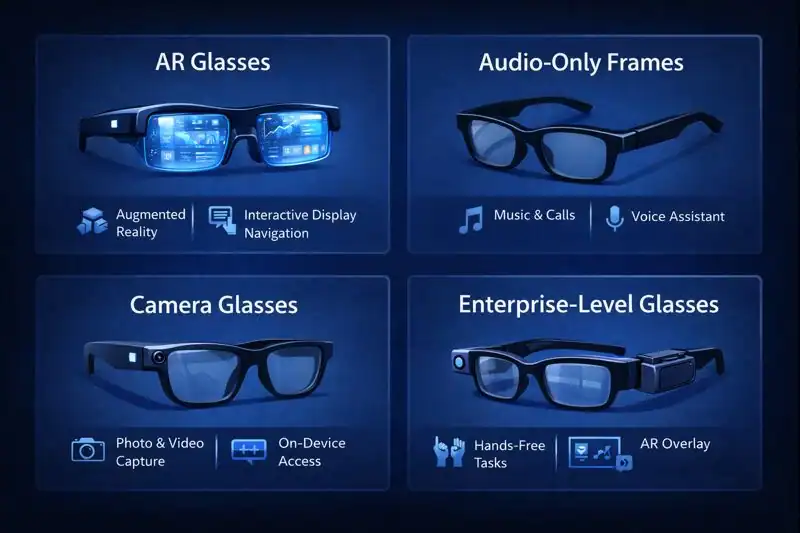
The world of smart eyewear isn’t one-size-fits-all. Different versions serve different needs. Let’s break them down.
Augmented Reality (AR) Glasses
These enhance your real-world view by overlaying digital elements. Think directions on sidewalks, restaurant reviews popping up over storefronts, or maintenance instructions hovering over equipment.
Example: A mechanic uses AR eyewear to see a 3D schematic of an engine while working on it.
Audio-Only Smart Glasses
These don’t have visual displays but include built-in speakers and microphones for music, calls, and voice assistants.
Example: A commuter listens to podcasts and answers calls hands-free during a train ride.
Camera-Equipped Glasses
Popular among content creators, these let you record video or take pictures from your point of view.
Example: A travel vlogger uses their wearable camera glasses to document a hike in the Alps—no handheld gear needed.
Enterprise Smart Glasses
Built for professional environments, these often come ruggedized with advanced sensors and integration with workflow software.
Example: A surgeon performs a procedure while getting real-time vitals and patient history through their digital eyewear.
How Do Smart Glasses Work?
Let’s demystify how these stylish pieces of futuristic technology actually function.
Step 1: Pairing and Setup
First, the glasses are paired with your smartphone or Wi-Fi network. This enables data syncing, software updates, and connection to your apps.
Step 2: Interaction Mode
Depending on the model, you can interact via voice commands, touch controls on the frame, or even gestures. Some advanced versions use eye tracking to detect where you’re looking.
Step 3: Display Activation
When activated, the micro display or projector renders digital content. It might appear on the lens itself or just above your direct line of sight to avoid obstruction.
Step 4: Real-Time Data Processing
Sensors gather environmental data—your location, movement, or lighting conditions. This info helps customize your visual feed in real-time.
Step 5: Output Delivery
You receive audio cues, visual overlays, or haptic feedback (like gentle vibrations) depending on the task—whether it’s a notification or a reminder to turn left.
Pros & Cons
Every piece of advanced technology comes with its perks and pitfalls. Here’s a balanced look at the strengths and challenges of smart eyewear.
| Pros | Cons |
|---|---|
| Hands-free access to info | Battery life can be limited |
| Stylish and discreet designs | Privacy concerns with cameras |
| Enhances productivity | Can be expensive |
| Integrates with other smart tech | Still emerging, not mainstream |
| Useful for special needs users | Some models lack app support |
Despite the drawbacks, these digital specs represent an exciting leap forward in innovation.
Uses of Smart Glasses

The beauty of smart glasses lies in their versatility. Let’s explore how they’re making waves in various industries and daily life.
Healthcare & Surgery
Surgeons can view live patient vitals or 3D models without looking away from their work.
Example: A neurosurgeon uses wearable displays to view brain scans mid-operation.
Industrial & Manufacturing
Technicians get hands-free guidance on repairs, quality checks, and inventory.
Example: A factory worker sees step-by-step assembly instructions projected directly into their view.
Education & Training
Students or trainees experience immersive learning through augmented visuals.
Example: Medical students explore a virtual cadaver in real-time during anatomy class.
Retail & E-Commerce
Employees can check stock levels, pricing, or scan barcodes without devices.
Example: A warehouse picker receives location-based item directions through their lenses.
Everyday Life
Navigation, translation, workouts, and even virtual meetings can be managed through your specs.
Example: A traveler walks through Tokyo with real-time sign translations floating in their glasses’ display.
Resources
- Wired – The Best Smart Glasses to Augment Your Reality
- TechCrunch – ar glasses
- CNET – A New Wave of Smart Glasses Are Coming
- Forbes – How Smart Wearables Are Shaping Our Future
- Wired – The Best Smart Glasses to Augment Your Reality