
In today’s connected world, every click, transaction, and login leaves behind digital traces. These traces, when analyzed, tell a story — one that can reveal vulnerabilities, attacks, or hidden threats. The challenge is seeing that story clearly amid billions of data points. That’s where Splunk comes in.
In the field of cybersecurity, Splunk is like a high-tech command center that turns chaos into clarity. It’s more than a tool — it’s a data-driven intelligence system that watches over your network, identifies suspicious behavior, and helps prevent potential breaches before they happen.
Imagine being able to see everything happening in your network in real time — every connection, every system log, every user action. it makes that possible. It’s the difference between reacting to a threat after the damage is done and preventing it before it begins. In an era where data is the new currency, it gives organizations the power to protect that wealth with precision and speed.
What is Splunk?
At its core, Splunk is a security information and event management (SIEM) platform that collects, indexes, and analyzes machine data from across your network. Think of it as a digital radar that continuously scans your IT environment, identifying unusual activity and alerting you before problems escalate.
Every piece of technology — from servers to applications — generates logs. Those logs are gold mines for cybersecurity analysts, but without the right tools, they’re impossible to decipher. it turns that raw, unreadable data into meaningful insights. It transforms endless streams of information into an understandable, visual map of what’s happening across your systems.
But what makes it truly valuable isn’t just its ability to monitor — it’s its intelligence. It detects patterns, correlates events, and gives context. Instead of simply telling you that an event occurred, it helps you understand why it happened, where it originated, and how to stop it.
Breaking Down the Technology
To appreciate how it works, imagine a city filled with security cameras. Each camera records activity — cars moving, people walking, doors opening — but without a central control room, those feeds are just noise. it acts as that control room, collecting every signal, analyzing it, and spotting anomalies that could indicate trouble.
The system gathers information from countless data sources such as firewalls, applications, routers, and operating systems. It then indexes this data, making it easy to search and filter. Analysts can look up specific activities, such as multiple failed logins from one IP address or suspicious outbound connections at odd hours.
One of Splunk’s most notable strengths is its visual dashboard. Instead of reading endless text-based logs, you can view trends and alerts in graphs, charts, and heatmaps. It transforms raw data into stories that security teams can act on instantly.
In addition, it integrates with machine learning to detect new and evolving threats. It doesn’t rely solely on pre-set rules — it learns from your environment, identifying unusual behaviors that could signal a potential breach.
History of Splunk
The story of it began in 2003 when three innovators — Michael Baum, Rob Das, and Erik Swan — wanted to make machine data more accessible and useful. They coined the term “Splunk,” inspired by “spelunking,” or exploring caves, to represent digging deep into data to uncover hidden insights.
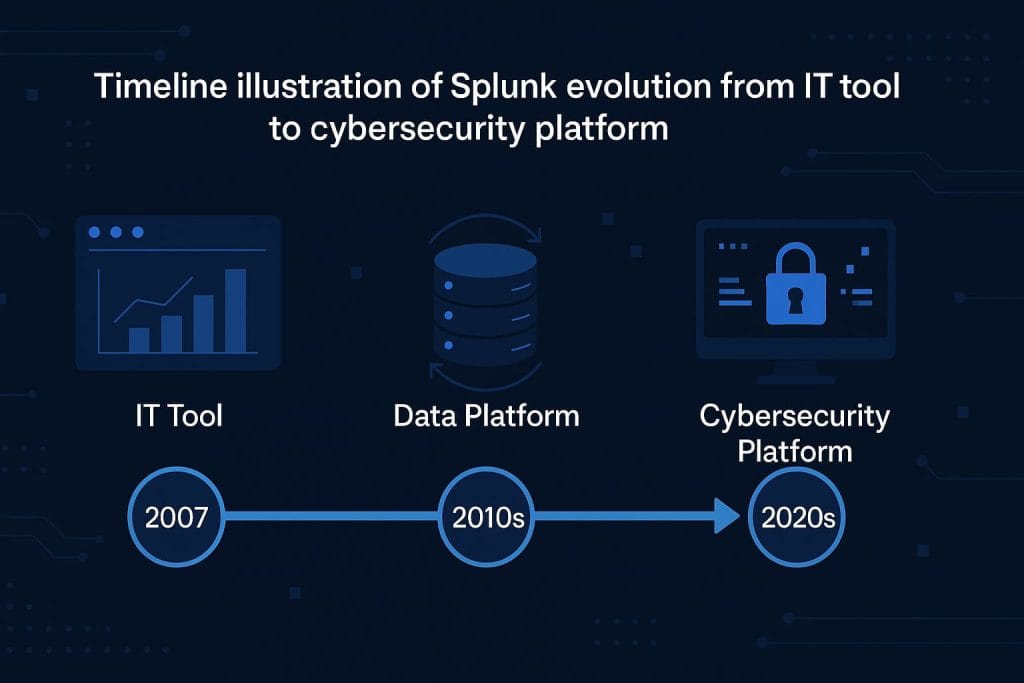
Initially, the platform was built for IT troubleshooting, helping teams find the source of system issues through log data. But as the digital world grew more complex, it became clear that the same approach could help tackle security threats.
Over the years, it evolved into a full-fledged data analytics and cybersecurity intelligence platform. By the early 2010s, it became one of the most trusted SIEM solutions worldwide, used by enterprises, governments, and cybersecurity experts.
| Year | Event | Description |
|---|---|---|
| 2003 | Splunk Founded | Developed to explore and analyze machine data. |
| 2007 | Public Release | Became a mainstream tool for IT data analysis. |
| 2013 | Security Focus | Introduced event correlation and threat monitoring. |
| 2018 | AI Integration | Added machine learning and automation for smarter detection. |
| 2020s | Cloud Evolution | Transitioned into cloud-based data intelligence systems. |
From log analysis to advanced security analytics, Splunk’s journey mirrors the evolution of cybersecurity itself.
Types of Solutions within Splunk
While many refer to “Splunk” as a single platform, it’s actually a comprehensive ecosystem of specialized tools tailored for different cybersecurity and IT use cases. Each product serves a unique purpose — from monitoring security events to automating responses and optimizing performance.
Splunk Enterprise Security (ES)
Splunk Enterprise Security (ES) is the flagship cybersecurity solution built for large-scale organizations that demand real-time visibility across their digital landscape. Acting as a Security Information and Event Management (SIEM) system, it centralizes data from multiple sources to detect, investigate, and respond to threats.
Splunk SOAR (Security Orchestration, Automation, and Response)
Splunk SOAR adds the power of automation to cybersecurity operations. It enables organizations to automatically detect, investigate, and respond to threats — drastically reducing manual workloads.
For example, if a malicious IP address is detected, SOAR can instantly isolate the affected system or block the IP — all without human intervention. By orchestrating complex workflows across multiple tools, it frees security analysts to focus on strategic threat hunting rather than repetitive tasks.
Splunk Cloud Platform
The Splunk Cloud Platform delivers the same analytical and security capabilities as its on-premise counterpart but with the flexibility of the cloud. It’s built for organizations that operate hybrid or fully remote infrastructures, offering scalability, reduced maintenance, and high availability.
Splunk Observability Cloud
Splunk Observability Cloud focuses on maintaining system health and performance while aligning with cybersecurity goals. It provides deep insights into applications, infrastructure, and user experience in real time.
How It Works
The core function of it is simple — collect, process, and analyze data — but the sophistication lies in how it handles scale and complexity.
Once it is deployed, it starts gathering logs from all connected systems: servers, applications, firewalls, and network devices. It then processes this data into structured indexes. Analysts can use Splunk Processing Language (SPL) to search through these indexes and identify events of interest.
For example, a security specialist might use it to detect multiple failed login attempts followed by a successful one from an unfamiliar device. That’s often a sign of credential theft or brute-force attempts. Its not only detects it but can automatically trigger alerts or actions based on pre-defined security rules.
Beyond reactive monitoring, It also provides predictive analysis. By recognizing patterns from historical data, it can forecast potential risks — giving organizations a chance to reinforce their defenses before an attack even begins.
Pros & Cons
Like any technology, Splunk has advantages and limitations, but its benefits in cybersecurity are undeniable.
| Pros | Cons |
|---|---|
| Delivers real-time visibility and analytics across systems. | Can be costly for smaller businesses or startups. |
| Provides customizable dashboards and automated alerts. | Requires technical expertise to configure effectively. |
| Integrates AI and machine learning for smarter detection. | Uses significant processing resources for large data sets. |
| Scales easily across hybrid and cloud environments. | May demand additional integrations for full automation. |
Despite a few challenges, Splunk remains a cornerstone of enterprise cybersecurity, balancing complexity with powerful intelligence.
Uses in Cybersecurity
Splunk has become an indispensable ally in modern cybersecurity operations, serving as both the watchdog and the analyst for digital systems. Its ability to collect, correlate, and visualize real-time data allows organizations to detect threats, investigate incidents, and maintain compliance with ease.
Threat Detection and Incident Response
In security operations centers (SOCs) worldwide, Splunk acts as the first line of defense. It continuously scans logs, traffic, and network activity for signs of compromise or unusual behavior. When a potential attack is detected, it provides full visibility — showing who accessed what, when, and how.
This level of transparency helps analysts respond quickly and accurately, minimizing damage from ransomware, phishing, or insider threats.
Digital Forensics and Investigation
Beyond prevention, Splunk plays a crucial role in cyber forensics. After a security incident, investigators use Splunk’s comprehensive logs to reconstruct the attack timeline, trace vulnerabilities, and understand how systems were breached.
Its ability to store and index massive datasets allows for deep historical analysis, ensuring that every trace of digital evidence is preserved and accessible for review.
Compliance and Regulatory Assurance
Organizations use Splunk not only to protect but also to comply. By automatically logging all activities, Splunk simplifies audit preparation and compliance reporting for standards like GDPR, HIPAA, and ISO 27001. It generates clear, traceable records that help businesses demonstrate data integrity and accountability.
Operational Intelligence and Performance Monitoring
Splunk’s integration of security and performance analytics enables teams to correlate system health with security posture. This makes it possible to detect performance anomalies that could signal a breach, ensuring that security and efficiency go hand in hand.
By leveraging Splunk Observability Cloud, companies can identify potential bottlenecks, optimize resources, and maintain continuous availability while reducing exposure to risk.
Resources
- Splunk: Official Splunk Documentation.
- Webasha: How Splunk Improves Cyber Threat Detection.
- Cisco: Integrating Splunk with Network Security Tools.
- TechTarget: What is Splunk and How It Enhances Security?
- Dark Reading: Modern Cybersecurity with Splunk Analytics.