
Cybersecurity is an ever-evolving field, requiring constant vigilance and innovative solutions to combat growing threats. One such solution is Security Information and Event Management (SIEM). SIEM combines security event management with information management to deliver advanced analytics and real-time monitoring, enabling organizations to detect and respond to cyber threats proactively.
Understanding Security Information and Event Management is crucial for businesses and IT professionals seeking to secure their networks and protect sensitive data. By leveraging SIEM tools, companies can ensure compliance with regulatory standards, gain valuable insights into security operations, and respond effectively to breaches or incidents.
As cyberattacks become more sophisticated, organizations need tools that can process massive volumes of security data quickly and accurately. SIEM helps close that gap by giving security teams a centralized way to see what is happening across their environment. Instead of manually reviewing logs from different tools, analysts can use SIEM to connect events, identify threats faster, and prioritize the incidents that need immediate attention.
What is Security Information and Event Management?
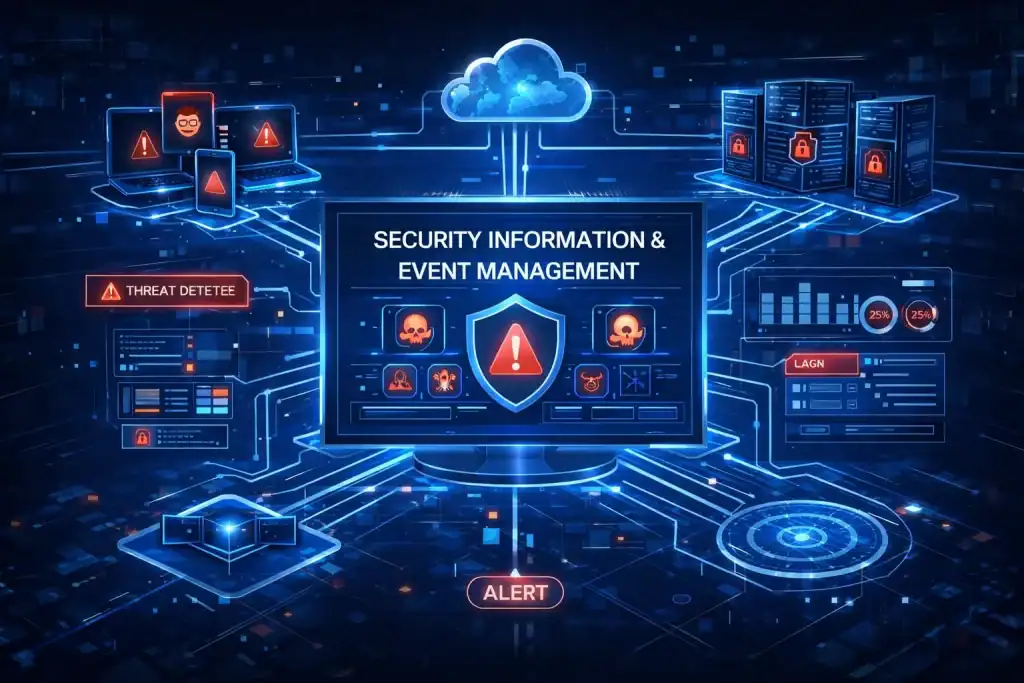
Security Information and Event Management (SIEM) refers to a sophisticated combination of security information management (SIM) and security event management (SEM). These systems collect, analyze, and correlate data from various sources across a network to detect and respond to potential security threats.
SIEM integrates log management, real-time analytics, and event correlation, providing IT teams with a centralized view of security activity. It leverages data from endpoints, applications, network infrastructure, and third-party systems to detect anomalies and uncover malicious activities.
In the realm of cybersecurity, Security Information and Event Management serves as both a defense mechanism and a compliance tool. Popular synonyms include “security data analytics” and “threat detection platform.” It’s widely regarded as the backbone of modern enterprise security management, helping companies handle complex security infrastructures effectively.
A major strength of Security Information and Event Management is its ability to turn raw machine data into actionable intelligence. Logs on their own can be difficult to interpret, especially in large organizations with hundreds or thousands of devices. SIEM makes this information easier to understand by organizing it into dashboards, alerts, and reports that support both daily monitoring and long-term security planning.
Background of Security Information and Event Management
SIEM tools operate by aggregating logs and events generated by diverse sources within an IT ecosystem. These sources can include firewalls, antivirus software, intrusion detection systems (IDS), and more. The primary function is to centralize this data, identify patterns, and flag suspicious behaviors that may indicate cyberattacks.
Security Information and Event Management systems rely on three core components:
Log Collection and Aggregation: Data from different network devices and endpoints is gathered for analysis.
Correlation and Analytics: Sophisticated algorithms identify relationships between seemingly unrelated events to detect potential threats.
Incident Response and Alerts: Automated responses or alerts enable quick actions to neutralize threats in real time.
For instance, if an employee’s credentials are used to log in from two distant locations within minutes, a SIEM system can detect this anomaly, flag it, and even lock the account until further investigation.
Organizations also use SIEM to comply with regulatory frameworks like GDPR, HIPAA, or PCI DSS, as these tools offer centralized reporting and evidence for audits.
In addition to security and compliance, Security Information and Event Management also improves visibility across the organization. Many businesses use a mix of cloud services, remote devices, and legacy systems, which can make monitoring difficult. A SIEM platform helps unify these environments so security teams can investigate incidents more efficiently and reduce blind spots that attackers often exploit.
History of Security Information and Event Management
The concept of SIEM evolved from the need to consolidate and streamline security operations in response to the increasing complexity of IT environments.
| Year | Event |
|---|---|
| 2000s | Emergence of log management systems for compliance requirements like SOX and HIPAA |
| Mid-2000s | Introduction of SIEM tools combining log management and event correlation capabilities |
| 2010s | Evolution of SIEM to include advanced threat detection and machine learning capabilities |
| 2020s | Modern SIEM platforms integrate artificial intelligence (AI) for predictive threat hunting |
SIEM began as a compliance-focused tool but quickly transitioned into a critical cybersecurity solution for organizations worldwide.
Over time, SIEM platforms became more intelligent and more adaptable. What started as a way to store and search logs has developed into a core part of modern security operations. Today, many SIEM solutions are integrated with automation, threat intelligence feeds, and behavioral analytics, allowing security teams to move from reactive monitoring to more proactive threat detection.
Types of Security Information and Event Management
SIEM systems can be categorized into various types based on their deployment models and functionalities:
| Type | Description |
|---|---|
| On-Premises SIEM | Deployed and managed within an organization’s infrastructure, offering complete control |
| Cloud-Based SIEM | Hosted on the cloud, offering scalability and reduced infrastructure management overhead |
| Hybrid SIEM | Combines on-premises and cloud-based solutions, providing flexibility and resilience |
| Open-Source SIEM | Community-driven platforms that are customizable but require significant technical expertise |
Choosing the right type of SIEM depends on an organization’s size, regulatory requirements, internal expertise, and budget. Smaller businesses may prefer cloud-based SIEM for easier deployment and lower maintenance, while larger enterprises may choose hybrid or on-premises models to meet stricter governance and data control requirements.
How Does Security Information and Event Management Work?
SIEM operates by collecting data from multiple systems and applying analytics to make sense of that data. Here’s a simplified breakdown:
Data Collection: Logs and events are gathered from network devices, servers, and applications.
Normalization: Data is standardized into a common format for consistency.
Correlation: Patterns and anomalies are detected using predefined rules and AI algorithms.
Alerts and Reporting: Notifications are sent to security teams for further action, and detailed reports are generated for compliance and analysis.
Modern SIEM platforms often incorporate AI and machine learning, enabling predictive analytics and faster detection of zero-day threats.
This process helps reduce the time between threat detection and response. Instead of waiting for manual review, security teams receive prioritized alerts based on risk level and context. This makes SIEM especially valuable in fast-moving threat environments where early detection can significantly reduce the impact of an attack.
Pros and Cons
| Pros | Cons |
|---|---|
| Centralized view of network activity | Can be expensive to deploy and maintain |
| Real-time detection and response to threats | Requires skilled personnel for effective management |
| Facilitates compliance with regulatory standards | May generate false positives, leading to alert fatigue |
| Improves efficiency by automating threat detection processes | Implementation can be complex for large-scale IT environments |
Although SIEM offers major benefits, success depends on proper configuration and management. Poorly tuned systems can overwhelm analysts with unnecessary alerts, while well-optimized platforms can dramatically improve detection quality and operational efficiency.
Applications or Uses of Security Information and Event Management
SIEM tools have a wide array of applications across industries, particularly in environments requiring advanced threat detection and compliance monitoring.
Enterprise Security Management
Organizations leverage SIEM to monitor their entire IT infrastructure, ensuring rapid identification and mitigation of threats.
Regulatory Compliance
SIEM simplifies the process of meeting compliance mandates by offering detailed audit logs and automated reporting features.
Incident Response
SIEM systems enable rapid incident response through automated workflows, helping organizations minimize downtime and data loss.
Industries Benefiting from SIEM
Financial Services: Detects and prevents fraud or insider threats.
Healthcare: Protects sensitive patient data and ensures HIPAA compliance.
Retail: Monitors for potential breaches in customer payment systems.
SIEM is especially useful in industries where security events must be tracked continuously and documented clearly. Beyond alerting teams to threats, it helps organizations build stronger reporting processes, improve internal accountability, and support better decision-making during security investigations.
Resources
- Gartner. SIEM Glossary
- IBM Think. SIEM Overview
- Imperva. What is SIEM?
- Microsoft Security 101. What is SIEM?
- TechTarget. Definition of SIEM