
In the fast-moving world of cybersecurity, where new threats emerge every second, defenders must think like attackers to stay ahead. One of the most powerful methods they use is reverse engineering — the digital art of taking things apart to understand how they work.
Reverse engineering allows cybersecurity specialists to dissect malicious code, uncover vulnerabilities, and strengthen systems from the inside out. It transforms mystery into knowledge, giving defenders the ability to anticipate cybercriminal tactics before they strike. Whether it’s analyzing malware or discovering flaws in closed software, reverse engineering remains the backbone of digital defense.
What is Reverse Engineering?
It is the process of deconstructing software, hardware, or systems to understand their inner workings. It’s like turning back the clock on code — breaking down compiled programs into understandable parts to see how they function.
In cybersecurity, it’s a critical practice for understanding malicious behavior, analyzing vulnerabilities, and recovering lost or undocumented information. By dismantling executables or firmware, analysts reveal hidden processes and security weaknesses that could otherwise remain invisible.
Other terms often used for reverse engineering include code analysis, binary inspection, software deconstruction, and malware analysis — each describing the same investigative concept from a different angle.
Breaking Down Reverse Engineering
It is often a three-stage process: disassembly, analysis, and reconstruction.
During disassembly, analysts use tools like IDA Pro, Ghidra, or Binary Ninja to convert machine code into readable assembly language. This reveals a program’s structure and logic, allowing investigators to trace what it does step by step.
The analysis stage focuses on how the program behaves when executed. Analysts may run suspicious software in a controlled sandbox, watching how it interacts with memory, files, or networks. This phase reveals payloads, hidden functions, or data exfiltration routines.
Finally, reconstruction takes insights from analysis to improve defenses. Security engineers create detection rules, develop patches, or design stronger protection systems based on what they learned.
Each phase deepens our understanding of how both malicious and legitimate software operate — knowledge that ultimately strengthens cybersecurity as a whole.
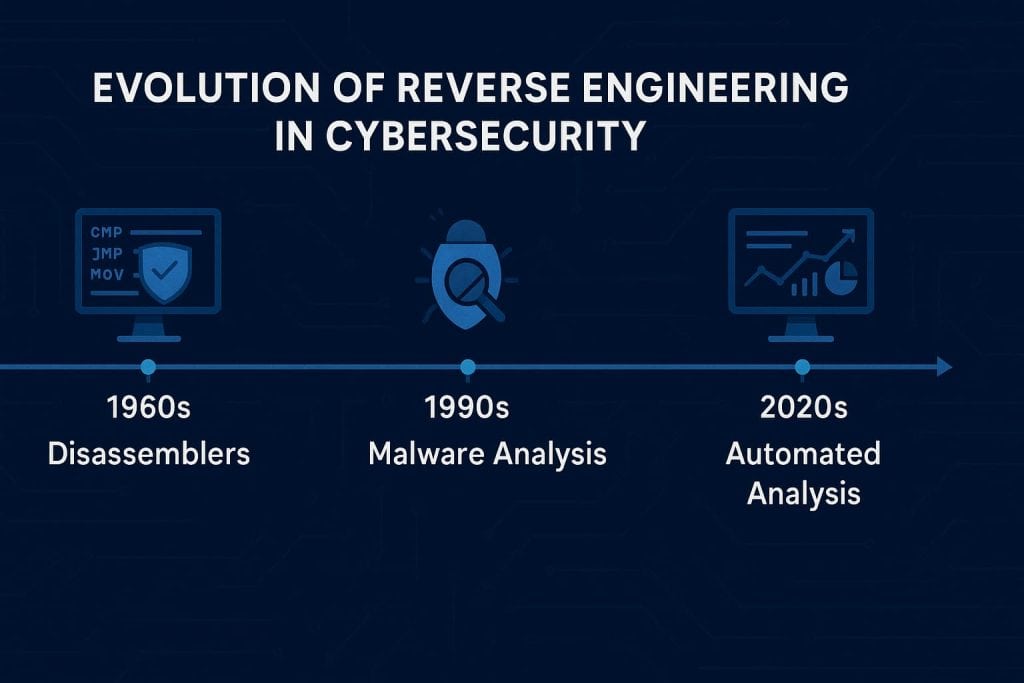
History of Reverse Engineering
Reverse engineering’s story began long before computers. Engineers have always examined existing designs to learn, replicate, or improve them. When digital systems emerged in the mid-20th century, this curiosity shifted to the realm of code.
By the 1970s and 1980s, researchers began disassembling early software to study functionality and identify flaws. When computer viruses first appeared, It became a necessity, helping pioneers build the first antivirus programs.
As systems grew more complex, specialized tools emerged to automate the painstaking process of decoding software and firmware. Today, It has evolved into a cornerstone of cybersecurity — essential for defense, research, and national security.
| Era | Milestone | Impact |
|---|---|---|
| 1970s | Hardware reverse engineering | Helped improve early computer architectures. |
| 1980s | Software disassembly | Enabled early malware and virus analysis. |
| 1990s | Rise of commercial software | Reverse engineering used for vulnerability research. |
| 2000s | Advanced debugging tools | Automation accelerated malware analysis. |
| 2010s–2020s | AI-powered disassembly | Machine learning enhances pattern recognition and analysis. |
Types of Reverse Engineering
It spans multiple branches within cybersecurity, each serving a distinct purpose.
Software Reverse Engineering
This type focuses on applications and executable files. Analysts decompile software to uncover its logic, verify security, and detect potential backdoors. It’s the most common form used in malware research and vulnerability discovery.
Hardware Reverse Engineering
Here, specialists examine the physical components of devices — chips, circuits, and firmware. They extract and analyze firmware to detect tampering, counterfeit parts, or embedded malware. This practice is crucial in supply chain and IoT security.
Network Protocol Reverse Engineering
This involves analyzing how systems communicate over networks. By studying data packets and connection behaviors, cybersecurity experts uncover undocumented APIs, insecure protocols, or hidden communications used in cyberattacks.
Malware Reverse Engineering
The most advanced branch, it dissects malicious code to identify attack methods, payloads, and persistence mechanisms. The resulting intelligence forms the backbone of antivirus definitions and threat-hunting strategies.
How Does Reverse Engineering Work?
It is part science, part detective work. It begins when analysts receive a suspicious file or observe abnormal system behavior.
The program is opened with tools like IDA Pro or Ghidra to expose its low-level instructions. Analysts trace how the code executes and where it stores data.
The software is run in a controlled virtual environment or sandbox. This step reveals runtime behaviors — network calls, file system changes, or memory injections — without risking infection.
Using debuggers like x64dbg or WinDbg, experts observe the program’s live execution, set breakpoints, and track hidden processes.
Once the data is collected, cybersecurity teams translate findings into actionable intelligence: patch recommendations, detection rules, or forensic evidence.
Reverse engineering transforms encrypted mystery into understanding — turning hidden threats into knowledge that protects.
Pros & Cons
Reverse engineering offers immense defensive value but comes with challenges in legality, ethics, and complexity.
| Pros | Cons |
|---|---|
| Uncovers malware behavior and attack patterns. | Can violate intellectual property if misused. |
| Helps discover and patch unknown vulnerabilities. | Requires expert knowledge and specialized tools. |
| Improves software security and reliability. | Time-intensive and technically demanding. |
| Essential for digital forensics and incident response. | Risk of handling live malicious code. |
When performed responsibly, reverse engineering strengthens trust, transparency, and resilience across the cybersecurity landscape.
Uses of Reverse Engineering
Reverse engineering isn’t just about breaking things apart — it’s about understanding, improving, and defending.
Malware Analysis and Threat Research
Cybersecurity experts reverse engineer malware samples to uncover how they infiltrate systems and spread. Insights from this process fuel antivirus databases and detection algorithms, keeping users safe from evolving threats.
Vulnerability Discovery
Analysts deconstruct proprietary or closed-source applications to find hidden flaws before criminals exploit them. Ethical hackers and researchers rely on these findings to develop patches and strengthen digital defenses.
Digital Forensics and Incident Response
When a breach occurs, reverse engineering helps reconstruct the attacker’s path. It identifies compromised files, command-and-control channels, and artifacts that reveal the full scope of the intrusion.
Intellectual Property and Hardware Security
Manufacturers use reverse engineering to verify product integrity, detect counterfeit components, or analyze firmware security. It ensures trust in hardware supply chains and critical infrastructure.
Resources
- IDA Pro: IDA Pro Disassembler and Debugger.
- NSA Ghidra: Ghidra Reverse Engineering Framework.
- SANS Institute: Reverse Engineering Malware Course.
- Scribd: Advanced Malware Analysis Techniques.
- CISA: Malware Analysis Reports.