
The Quantum Internet sounds like something you’d overhear in a sci-fi movie—until you realize researchers are already building pieces of it in real fiber networks. The big idea behind the Quantum Internet is simple but wild: instead of sending information as ordinary 0s and 1s, future networks could use quantum states that are incredibly hard to copy or spy on. In the communication-technology category, this matters because security threats keep rising while our current internet was never designed for a world of constant attacks, data harvesting, and “decrypt later” risks.
Learning what the Quantum Internet is (and what it is not) helps you understand where cybersecurity, networking, and next-gen computing may be heading. It’s also a useful reality check: this isn’t replacing the internet tomorrow—it’s a specialized network layer that could unlock new capabilities like ultra-secure links and distributed quantum computing.
What is Quantum Internet?
The Quantum Internet is a theorized and emerging network concept that connects quantum devices—like quantum computers and quantum sensors—so they can transmit information encoded in quantum states rather than classical bits. Synonyms you’ll see include “quantum networking” and “quantum communication networks,” and the key promise is that communication can become fundamentally more secure because measuring or copying quantum states can disturb them, making eavesdropping detectable.
Breaking Down Quantum Internet
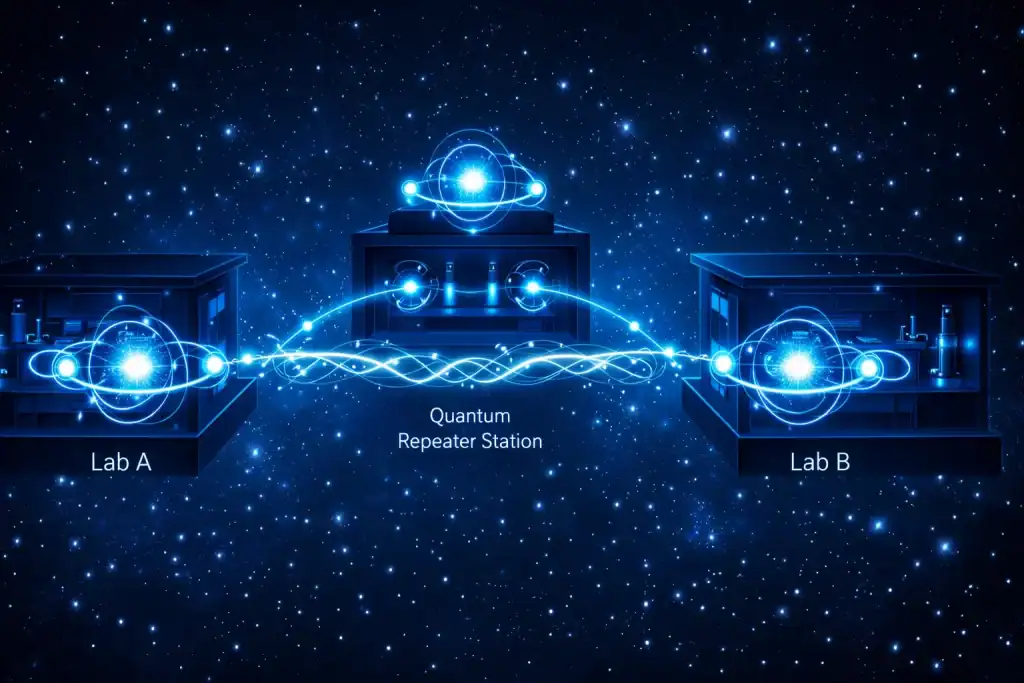
To understand the Quantum Internet, picture two layers: a familiar classical layer (the internet you use now) and a quantum layer that handles special tasks that classical networking struggles with—especially secure key exchange and connecting quantum processors. That’s why many experts describe the Quantum Internet as coexisting with today’s internet rather than replacing it.
At the heart of the Quantum Internet are qubits and photons. Qubits (quantum bits) can represent more complex states than classical bits because of quantum rules like superposition. Photons—single particles of light—are often used to carry quantum information through fiber cables. But quantum signals are fragile: they can be disturbed by noise, loss, and even temperature shifts, which is one reason scaling this network is so hard.
A key “superpower” often associated with the Quantum Internet is entanglement. Entanglement links two quantum particles so their states are correlated in a way classical physics can’t replicate. In networking terms, entanglement is useful because it enables quantum teleportation (teleporting a state, not a physical object). Teleportation can help move quantum information between nodes without sending the qubit itself end-to-end in the same way a normal packet travels.
Here’s a practical example: quantum key distribution (QKD). QKD is a method for creating shared encryption keys using quantum properties; if an attacker tries to intercept the signal, the quantum state is disturbed and the intrusion can be detected. QKD is often described as an early building block on the road to a broader quantum network vision.
One more crucial component is the quantum repeater. Classical repeaters can amplify and copy data packets easily, but quantum states can’t be copied in the same straightforward way. Quantum repeaters aim to extend distance by building entanglement across segments—an engineering hurdle repeatedly flagged as central to building a scalable network.
If this all sounds like futuristic technology, it is—but the motivation is practical: a network where high-value data can be protected against interception at a physics level, not just by math.
History
Quantum computing and quantum communication technologies sparked the origins of the Quantum Internet. Physicists first explored the use of quantum particles for communication in the 1980s, laying the experimental foundations. Researchers then made significant breakthroughs in quantum networking during the late 1990s and early 2000s by developing quantum key distribution (QKD) protocols. These efforts quickly moved from theory to practice, leading to the construction of the first quantum communication networks, such as the Quantum Network in Vienna.
| Year | Event |
|---|---|
| 1980s | First concepts of quantum communication explored |
| 1990s | Quantum key distribution (QKD) developed |
| 2010s | First experimental quantum communication networks |
| 2020s | Development of large-scale Quantum Internet |
Types of Quantum Internet
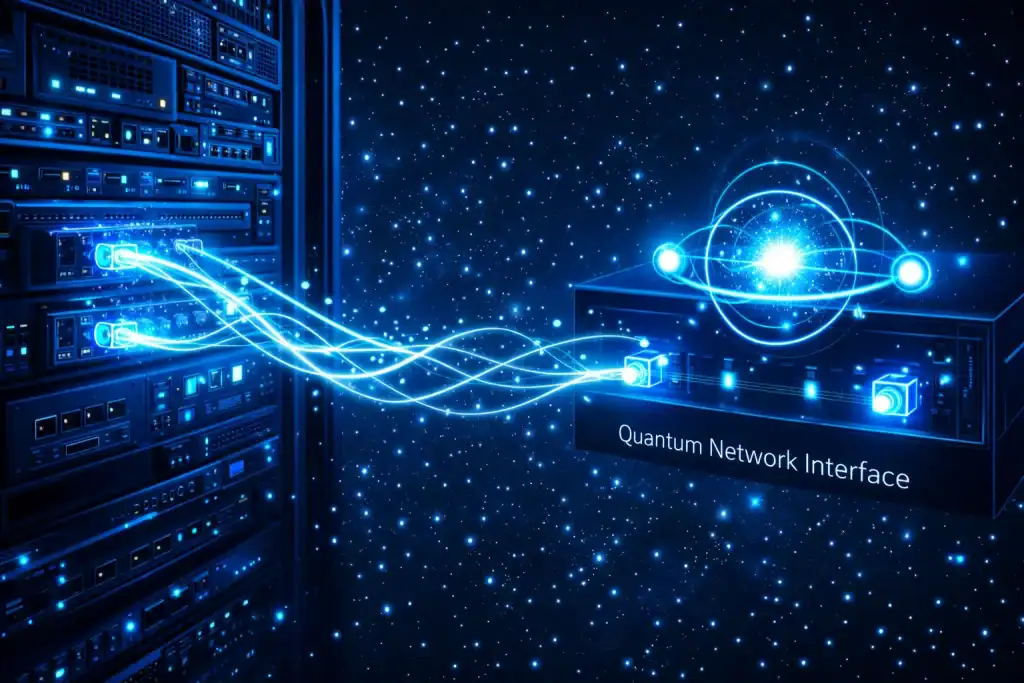
The Quantum Internet is often discussed as a family of approaches rather than one single design. Different “types” emphasize different goals—secure keys, entanglement distribution, or gradual hybrid upgrades.
Quantum Key Distribution Networks
These focus on generating and sharing encryption keys using quantum properties. They are among the earliest real-world quantum networking applications and are often positioned as a security stepping stone toward broader networks.
Quantum Teleportation and Entanglement Networks
These aim to distribute entanglement between nodes and use teleportation of quantum states to connect quantum processors or sensors. Demonstrations of teleportation over fiber carrying live internet traffic suggest possible coexistence with classical channels.
Hybrid Quantum–Classical Networks
These blend today’s routing and fiber infrastructure with quantum signals or quantum-safe workflows. Experiments showing quantum signals alongside classical traffic and work toward standard Internet Protocol compatibility are steps in this direction.
| Type | Primary goal | Near-term readiness |
|---|---|---|
| QKD networks | Secure key exchange | Higher (already deployed in pilots) |
| Entanglement/teleportation networks | Connect quantum nodes | Medium (active research + demos) |
| Hybrid networks | Compatibility + gradual rollout | Medium-to-high (increasing trials) |
How Does Quantum Internet Work?
It works by transmitting quantum information—in the form of qubits—over long distances through a process known as quantum entanglement. Entangling two qubits links them, so the state of one qubit instantly influences the other, no matter how far apart they are. This enables the secure transfer of data across quantum networks. Additionally, quantum repeaters play a key role in extending the range of these networks by maintaining the integrity of entangled qubits over greater distances.
In practice, sending quantum data causes any interception attempt to disrupt the quantum state, immediately alerting the communicating parties to the breach. This makes it inherently more secure than current internet protocols.
Pros & Cons
The promise of the Quantum Internet is exciting, but the trade-offs are real. Think of it as advanced technology that delivers powerful new security capabilities while demanding expensive, delicate infrastructure.
| Pros | Cons |
|---|---|
| Eavesdropping is detectable in many protocols | High cost and complex hardware needs |
| Enables new networking functions (entanglement/teleportation) | Quantum signals are fragile and hard to scale |
| Could connect quantum processors for new computing models | Repeaters and standards still maturing |
Uses of Quantum Internet
The Quantum Internet isn’t just a “faster internet” story—it’s a “different capabilities” story. Below are practical ways it could show up once the infrastructure matures. (And yes, plenty of new inventions will be built on top of these foundations.)
Cybersecurity and Government-Grade Communication
If your nightmare is “someone copied our traffic and will crack it later,” quantum approaches like QKD can reduce risk by making interception detectable, improving trust in high-stakes channels. This is especially valuable for defense, diplomacy, and critical infrastructure.
Distributed Quantum Computing and Research Collaboration
One long-term goal is connecting quantum computers so tasks can be shared across nodes—useful for simulation-heavy fields like materials science and drug discovery. A linked network of quantum devices could support new computation workflows that aren’t feasible when every system is isolated.
Financial Services and High-Value Transactions
Banks care about integrity, authentication, and preventing interception. Quantum-secured key exchange could harden transaction pipelines and protect against sophisticated attackers.
Smart Cities and Sensing Networks
As cities deploy iot devices for traffic, energy, and public services, there’s growing interest in stronger security and tamper detection. Quantum-enhanced sensing and secure links could protect sensitive operational data and prevent stealthy interference. This is where Innovation becomes less about gadgets and more about trust in the systems that run daily life.
If you’re searching for a generic organic keyword like secure communication, this is exactly the umbrella benefit: building channels where privacy and integrity are protected by physics plus protocol design—not only by software patches.
Resources
- University of Chicago. Quantum Internet Explained
- ZDNet. What is the Quantum Internet? Everything You Need to Know
- University of Chicago News. Quantum Internet Explained
- TechTarget. What is Quantum Internet?
- New York Times. The Future of Quantum Internet and Teleportation