
In the dynamic world of blockchain and cryptocurrency, understanding specific ecosystems is essential for making informed decisions and staying ahead of trends. Among these, the Solana Ecosystem has emerged as a game-changer due to its high-speed transactions, low fees, and scalability. This thriving network supports a wide range of applications, from decentralized finance (DeFi) platforms to gaming platforms and NFT marketplaces. However, its unique technology and terms can be overwhelming for beginners. In this glossary-style guide, we break down the key terms and concepts of the Solana Ecosystem to help you navigate it with confidence.
What is the Solana Ecosystem?
The Solana Ecosystem encompasses the applications, tools, and protocols built on the Solana blockchain. Known for its lightning-fast transaction speeds and cost-efficiency, Solana is powered by its innovative proof-of-history (PoH) consensus mechanism. This enables developers to build scalable and secure decentralized applications while maintaining low operational costs.
Synonyms and related terms often include “Solana blockchain” or “Solana network.” Central to the ecosystem is the SOL token, which facilitates transactions, staking, and governance. Applications like the Solana Wallet allow users to interact with this robust network.
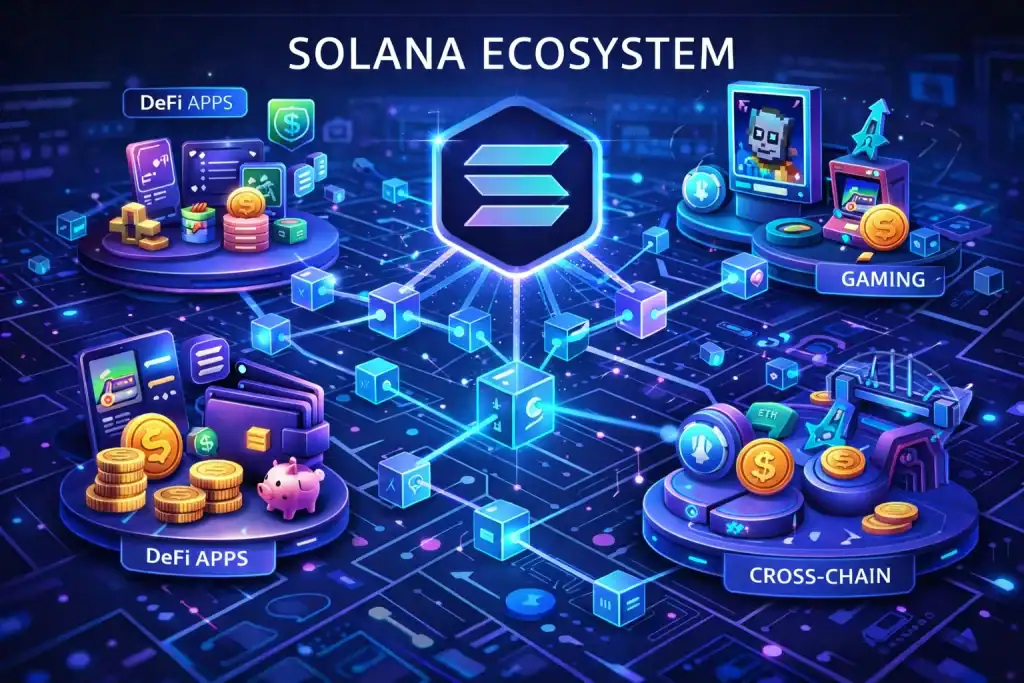
For beginners, the easiest way to think about the Solana Ecosystem is as a digital city built for speed. Some parts of that city help people trade tokens, others support NFT collections, and some power blockchain-based games or developer tools. Instead of existing as one single app, the ecosystem is a growing collection of connected platforms working together on the same network. That’s what makes Solana so exciting for newcomers: once you understand the basics, you begin to see how all the pieces fit together.
Breaking Down Solana Ecosystem
The Solana Ecosystem stands out for its ability to handle a high volume of transactions at unprecedented speeds. At its core is the proof-of-history (PoH) mechanism, which timestamps transactions to ensure proper sequencing. Combined with proof-of-stake (PoS), this design achieves an optimal balance between security, speed, and decentralization.
Key components of the Solana Ecosystem include:
Blockchain Infrastructure: Solana’s PoH technology ensures faster transaction finality compared to traditional blockchains.
SOL Token: Serving as the network’s native cryptocurrency, SOL powers transactions, staking, and smart contract execution.
Smart Contracts: These programmable contracts automate processes within decentralized applications (dApps).
Developer-Friendly Ecosystem: Solana provides a robust suite of tools for developers to create efficient dApps.
For instance, platforms like Serum and Raydium use Solana to execute real-time financial transactions, while NFT marketplaces like Magic Eden leverage its low fees to facilitate seamless trading.
Another reason these fundamentals matter is accessibility. A blockchain can be technically impressive, but if it feels slow, expensive, or confusing, users often lose interest. Solana’s appeal comes from how its infrastructure supports smoother user experiences. Fast confirmation times and lower fees make simple actions like minting an NFT or swapping tokens feel less intimidating, especially for first-time users entering Web3.
History of the Solana Ecosystem
The Solana blockchain was founded by Anatoly Yakovenko in 2017, with the mainnet officially launched in 2020. Its development was driven by a need for a more scalable blockchain capable of overcoming Ethereum’s congestion and high fees. Solana quickly gained traction, becoming a hub for decentralized finance and NFTs.
| Year | Event |
|---|---|
| 2017 | Initial development of Solana begins |
| 2020 | Solana Mainnet Beta launched |
| 2021 | Rise of Solana NFTs and dApps |
| 2022 | Major integrations with Web3 platforms |
Types of the Solana Ecosystem
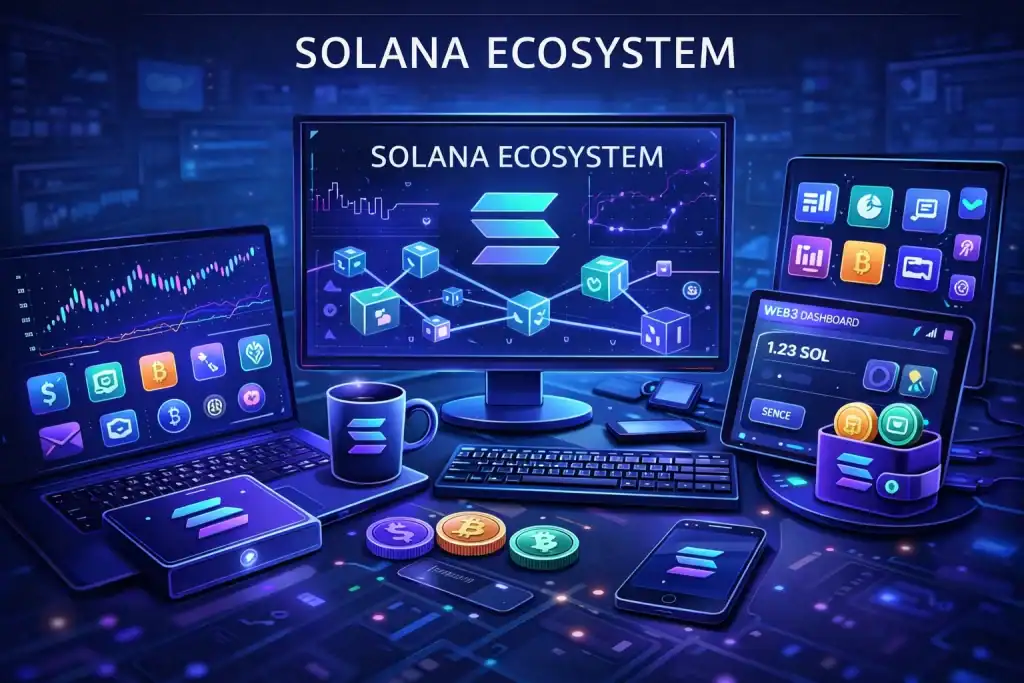
The Solana Ecosystem is diverse, catering to multiple use cases and industries.
| Category | Key Features | Examples |
|---|---|---|
| DeFi | Real-time trading, lending, liquidity pools | Serum, Raydium |
| NFTs | Minting, trading, digital art marketplaces | Magic Eden, SolSea |
| Gaming Platforms | Tokenized assets, immersive gaming experiences | Star Atlas, Aurory |
| Infrastructure Tools | Developer APIs, frameworks | Wormhole, Metaplex |
| Wallets & User Tools | Secure storage, transaction management | Phantom, Solflare |
Each category plays a crucial role. For instance, DeFi platforms use Solana’s speed for efficient trading, while gaming platforms tokenize in-game assets.
How Does the Solana Ecosystem Work?
At the heart of the Solana Ecosystem is its hybrid consensus mechanism. The proof-of-history system timestamps events to provide a verifiable order, while proof-of-stake ensures network security by validating transactions through staked tokens.
This combination results in unparalleled transaction speed and cost efficiency, making Solana ideal for high-demand applications such as DeFi and Web3 gaming.
In more practical terms, this means users do not have to wait long for most actions to be processed. When someone sends SOL, interacts with a game, or buys a digital collectible, the network is designed to keep things moving quickly. For developers, that speed opens the door to building apps that feel more like modern consumer platforms and less like slow experimental tools. That user experience is a major part of why the ecosystem has attracted so much attention.
Solana Ecosystem Pros & Cons
While the Solana Ecosystem offers numerous advantages, it also faces challenges.
| Pros | Cons |
|---|---|
| Ultra-fast transaction processing | Occasional network congestion |
| Low transaction fees | Centralization concerns |
| Developer-friendly environment | Network stability issues during surges |
Uses of the Solana Ecosystem
The Solana Ecosystem is a powerful enabler across a wide range of industries, transforming the way businesses and individuals interact with blockchain technology. Its applications extend beyond conventional cryptocurrency use, pushing the boundaries of what’s possible with decentralized systems.
Token-Based Transactions
Solana’s primary utility revolves around its SOL token, which powers all network activities. The token is used for staking, paying transaction fees, and participating in governance. Additionally, developers create new tokens on Solana’s infrastructure to support DeFi platforms, gaming economies, and community-driven initiatives.
Streamlined Decentralized Finance (DeFi)
Solana drives innovation in DeFi by offering tools for peer-to-peer financial services. Platforms built on Solana allow users to trade assets, earn interest, and provide liquidity in decentralized exchanges. By eliminating intermediaries, Solana reduces costs and improves transaction speed, empowering users in global markets.
Non-Fungible Tokens (NFTs)
The Solana Ecosystem enables artists and collectors to create, buy, and sell NFTs efficiently. Its cost-effectiveness makes it a preferred platform for launching NFT projects. For example, Magic Eden provides an ecosystem where users can discover and trade NFTs, while projects like Degenerate Ape Academy have gained significant popularity within the community.
Web3 Gaming Platforms
Gaming platforms powered by Solana utilize its infrastructure to provide unique features like in-game economies, asset tokenization, and rewards systems. Games like Star Atlas use Solana to offer players ownership of their digital assets, creating a seamless integration between gameplay and blockchain functionality.
Cross-Chain Interoperability
With tools like Wormhole, the Solana Ecosystem enables interoperability between blockchains. This allows assets and data to move freely across networks, fostering collaboration and innovation in the decentralized space. For example, users can bridge tokens from Ethereum to Solana and vice versa.
Decentralized Applications (dApps)
Solana supports a wide variety of dApps, from decentralized exchanges to social platforms. Developers choose Solana for its scalability and speed, ensuring seamless user experiences even during peak network activity.
Through these diverse use cases, the Solana Ecosystem continues to expand its influence across industries, demonstrating its flexibility and future potential.
Resources
- Solana. Terminology Guide.
- Investopedia. What is Solana?.
- Medium. Unlocking the Power of Solana: A Beginner’s Guide.
- NeoEVM. Common Solana Terminology.
- TechTarget. Blockchain Terminology: A Glossary for Beginners.