
In the world of cybersecurity, knowing how cyberattacks unfold is half the battle. That’s where the Cyber Kill Chain comes in. This framework breaks down the steps attackers take to infiltrate systems, making it easier for organizations to detect and stop threats before they succeed. Whether you’re an IT professional or someone curious about how hacking works, understanding this chain can give you a clearer picture of how cyberattacks occur and how they can be prevented.
In this blog, we’ll explore this chain in detail. From its origins to its practical uses, we’ll break it down step by step. By the end, you’ll have a solid understanding of this essential cybersecurity concept and how it helps protect against cyber threats.
What is Cyber Kill Chain?
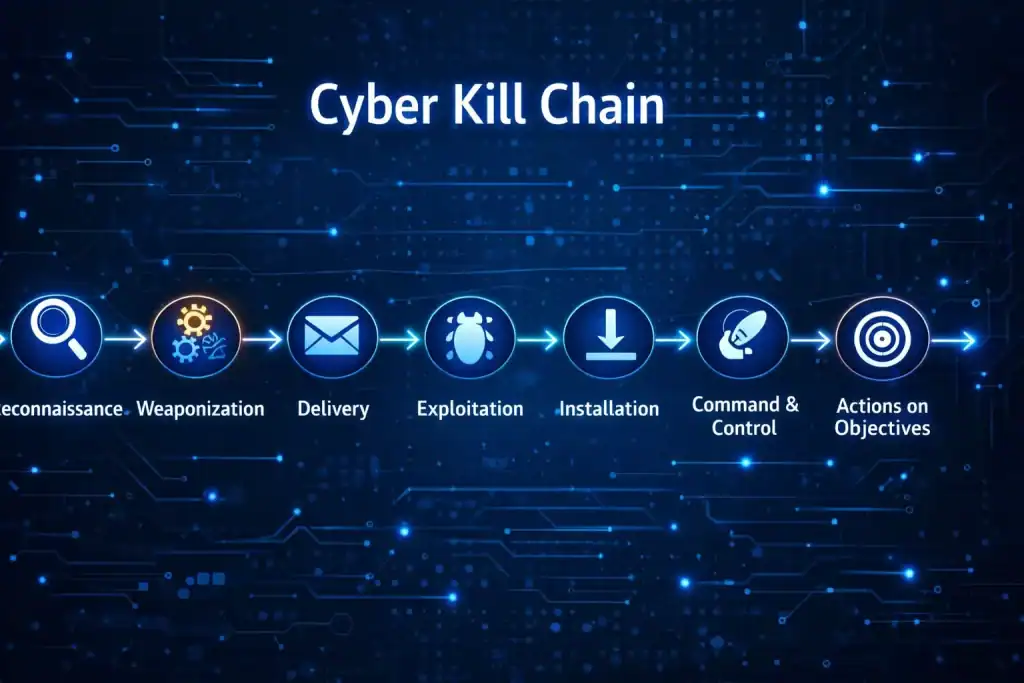
This is a cybersecurity framework that identifies the stages of a cyberattack. It was developed by Lockheed Martin to help organizations understand, detect, and prevent attacks by breaking them into a series of steps.
Think of it as a roadmap for attackers. Each step represents a phase in their journey to infiltrate systems, steal data, or disrupt operations. By identifying these steps, cybersecurity teams can disrupt the attack at various stages, reducing the impact or stopping it altogether.
The term “kill chain” comes from military terminology, where it refers to the steps required to target and eliminate a threat. In cybersecurity, it’s also called the “attack lifecycle” or “cyberattack chain.”
Breaking Down Cyber Kill Chain
To understand the Cyber Kill Chain, imagine a burglar casing a neighborhood before attempting a break-in. They do not simply appear at a window with no preparation. They study the area, look for weaknesses, choose a method, enter quietly, and then try to stay unnoticed long enough to get what they came for. Cyberattacks often follow that same pattern, only the neighborhood is your network and the open window might be an unpatched system or a careless click on a fake email.
The first stage is reconnaissance, where attackers gather information. They might scan websites, inspect public employee profiles, or search for exposed systems. Next comes weaponization, where they prepare a malicious file, phishing lure, or exploit tailored to that target. Delivery follows, which is the moment the threat reaches the victim, often through email attachments, links, compromised websites, or infected devices.
After delivery comes exploitation. This is where the attacker takes advantage of a weakness, whether that is outdated software or human error. Then comes installation, when malware or another tool is placed on the system to maintain a foothold. After that, attackers establish command and control, often shortened to C2, which allows them to communicate with the compromised environment remotely. Finally, they move to actions on objectives, meaning the real goal of the attack: stealing files, encrypting data, disrupting systems, or expanding through the network.
What makes the Cyber Kill Chain valuable is that it gives defenders multiple places to act. A suspicious scan can be blocked early. A phishing message can be filtered before anyone clicks. A strange outbound connection can raise an alert before sensitive data leaves the building. This is why the framework remains useful: it turns a complex attack into understandable stages and helps organizations focus on prevention, visibility, and response. In practice, the Cyber Kill Chain helps teams think less like victims reacting too late and more like investigators watching every move before the damage is done.
History of Cyber Kill Chain

This chain was developed by Lockheed Martin in 2011 as part of its intelligence-driven defense strategy. The framework was inspired by military strategies that focus on identifying and neutralizing threats before they can cause harm.
Initially, the Cyber Kill Chain was used to combat advanced persistent threats (APTs). Over time, it became a widely adopted tool for understanding and defending against various types of cyber threats.
| Year | Event | Impact |
|---|---|---|
| 2011 | Lockheed Martin introduces Cyber Kill Chain | Revolutionizes attack analysis and defense |
| 2015 | Adoption by cybersecurity organizations | Becomes a standard framework for APTs |
| Present Day | Used across industries for threat mitigation | Expands to address evolving cyber tactics |
How Does Cyber Kill Chain Work?
This chain works by helping organizations identify and disrupt attacks at any stage. For example, during the reconnaissance phase, cybersecurity teams can detect unusual scanning activity and block the attacker’s access. Similarly, during the delivery phase, email filters can stop phishing attempts before they reach users.
The framework’s structured approach allows teams to prioritize their defenses and focus on the most critical areas. It’s like having a map of the attacker’s journey, making it easier to cut them off at key points.
Types of Cyber Kill Chain
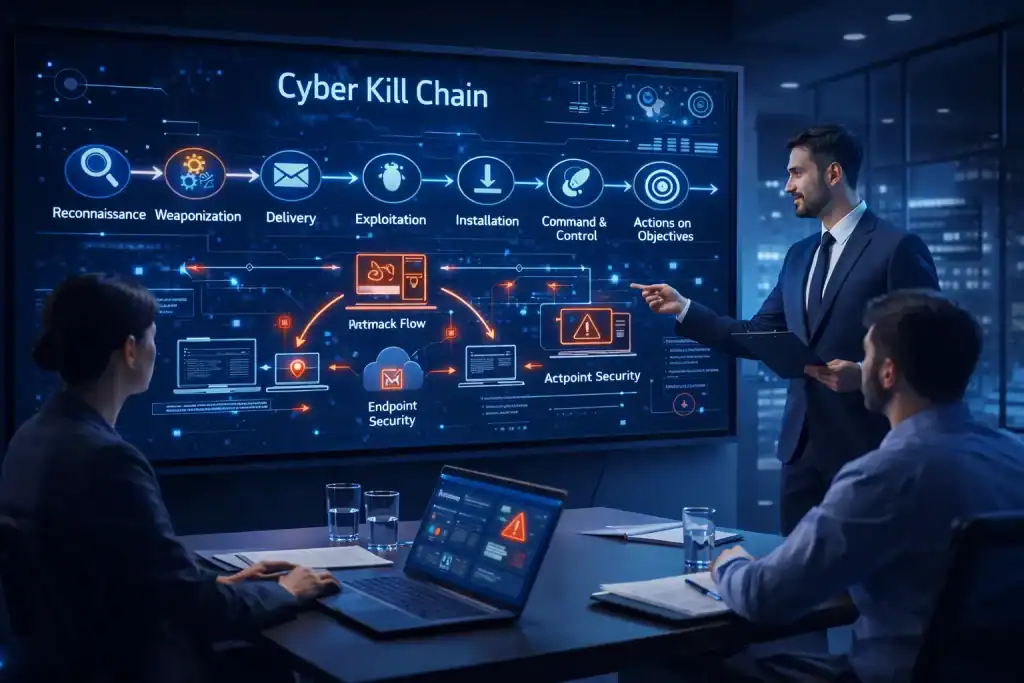
There are different variations of the Cyber Kill Chain, each adapted to specific use cases or industries.
Traditional Kill Chain
The traditional kill chain follows Lockheed Martin’s seven-step framework and focuses on external threats. It helps security teams detect and stop attacks like phishing or ransomware at various stages. For example, during the reconnaissance phase, unusual scanning activity can alert teams to block access early.
Extended Kill Chain
The extended kill chain adds internal threats to the traditional framework. It covers insider risks like employees mishandling sensitive data or intentionally misusing their access. This version also tracks accidental data leaks, providing a more comprehensive view of potential vulnerabilities within an organization.
MITRE ATT&CK Framework
The MITRE ATT&CK Framework offers a detailed view of attacker tactics, techniques, and procedures (TTPs). Unlike the traditional kill chain, it focuses on specific methods attackers use at each phase, such as bypassing authentication or escalating privileges. This detailed approach is particularly useful for defending against advanced persistent threats (APTs).
Pros & Cons
| Pros | Cons |
|---|---|
| Helps identify and stop attacks early | May not address all modern attack methods |
| Provides a clear framework for analysis | Requires skilled personnel to implement |
| Enhances threat visibility and response | Focuses more on external threats |
| Supports proactive threat hunting | Can be time-consuming to apply fully |
While the Cyber Kill Chain is highly effective, it’s not a one-size-fits-all solution. It works best when combined with other security practices.
Uses of Cyber Kill Chain
This chain is used by organizations across industries to understand and mitigate threats.
Preventing Data Breaches
The Cyber Kill Chain helps stop attacks by identifying vulnerabilities early. For example, security teams can block phishing attempts during the delivery phase or detect suspicious scans in the reconnaissance phase. This proactive approach reduces the chances of sensitive data being compromised.
Improving Threat Hunting
Threat hunters use this Cyberattack chain to track and counter attacker behaviors. It helps them focus on high-risk phases, like exploitation, to uncover hidden threats. For instance, repeated login attempts from unknown locations can be flagged as part of the command and control phase, enabling quicker action.
Enhancing Incident Response
The Cyber Kill Chain guides incident response by providing clear steps to follow during an attack. Teams can identify and remove malware in the installation phase or block attackers during command and control to minimize damage and recovery time.
Organizations rely on the Cyber Kill Chain to stay one step ahead of attackers and protect sensitive information.
Resources
- ECCouncil. Cyber Kill Chain: Seven Steps of a Cyberattack
- SOC360. Cyber Kill Chain Guide
- Instlytics. Understanding the Cyber Kill Chain
- Startup Defense. Guide to Cyber Kill Chain
- Medium. Understanding Cyber Kill Chain