
Federated learning is revolutionizing the way data is utilized in the age of machine learning and artificial intelligence. As businesses and organizations increasingly prioritize data privacy, understanding it has never been more important. This transformative technology enables decentralized data processing, offering solutions for data-driven decision-making without compromising individual privacy. In a world where regulations and customer trust matter more than ever, Federated Learning offers a practical path to “learn from data” without “moving the data.”
In this article, we’ll unpack the essence of Federated Learning, dive into its history, explore its types, and examine its applications in modern industries. We’ll also look at the real-world trade-offs—like performance, infrastructure requirements, and security safeguards—so you can evaluate whether Federated Learning fits a specific use case.
What is Federated Learning?
Federated learning (FL) is a decentralized approach to machine learning that enables model training across multiple devices or servers while keeping the data localized. Unlike traditional methods that consolidate data in a central server, it emphasizes privacy and security by ensuring sensitive information never leaves its original source. This is especially valuable when data sharing is restricted by law (healthcare), contracts (finance), or practical risk (consumer devices).
Synonyms for Federated Learning include “collaborative machine learning,” “decentralized learning,” and “privacy-preserving machine learning.” This paradigm has gained traction in fields like healthcare, finance, and mobile technology, where privacy compliance is paramount. By design, Federated Learning empowers collaborative intelligence across distributed networks, making it a cornerstone of ethical AI. It also reduces the “honeypot” risk of storing massive datasets in one place, which can become an attractive target for attackers.
Breaking down Federated Learning
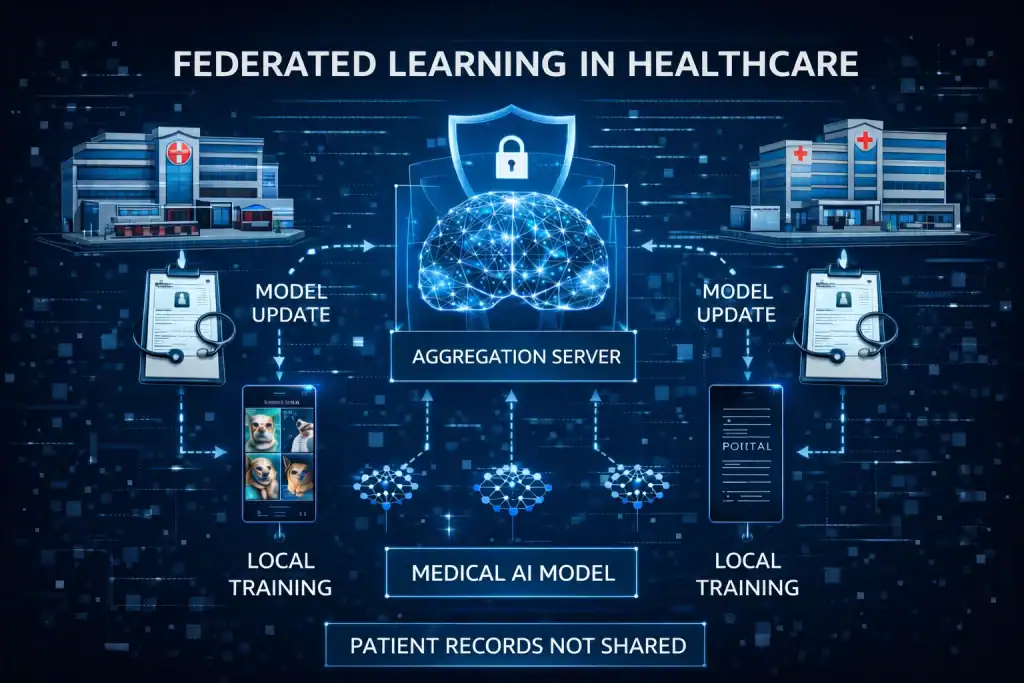
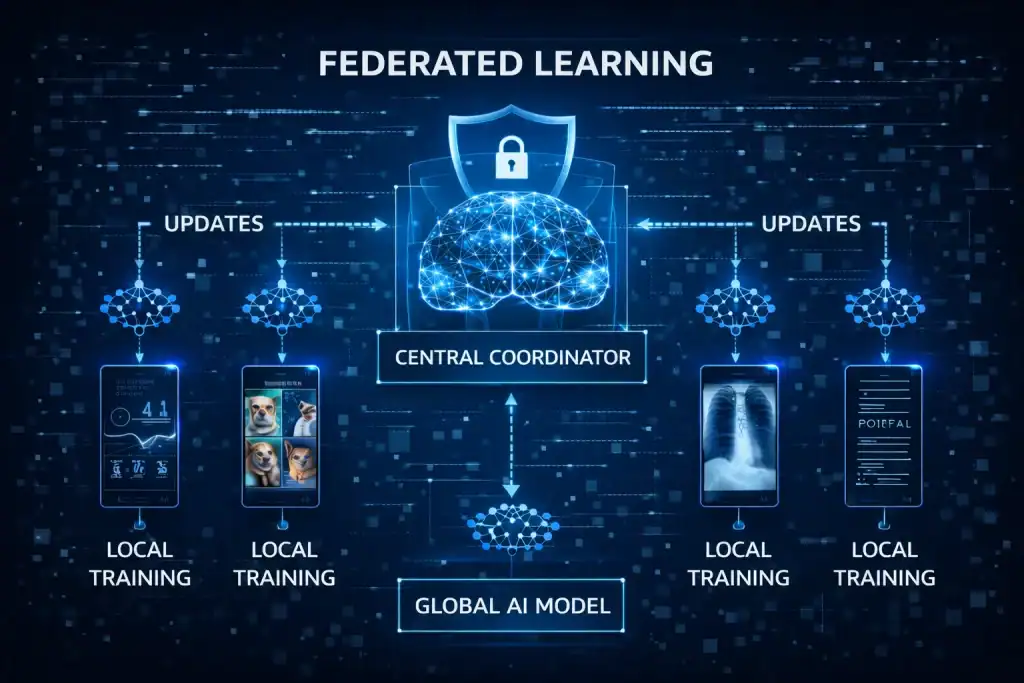
Federated Learning functions by leveraging local data stored across a network of devices or nodes. Instead of transferring raw data to a central repository, FL algorithms transmit updates from local models to a central server, which aggregates them to improve a global model. Think of it as sending “what the model learned” rather than sending the raw examples it learned from.
For example, in healthcare, it can enable hospitals to collaboratively train an AI model to predict diseases without sharing sensitive patient data. This collaboration becomes especially useful when no single hospital has enough diverse data to build a highly accurate model on its own.
Key Components
- Local Training: Each device independently trains a model using its own data.
- Model Aggregation: Updates from local models are aggregated into a central global model.
- Privacy Measures: Encryption, differential privacy, and secure multiparty computation ensure data security.
It’s important to note: Federated Learning protects raw data location, but privacy still requires careful design. Model updates can sometimes leak information if not protected, which is why secure aggregation and privacy techniques matter in real deployments.
Consider predictive text models in smartphones. Each phone trains its model locally, and updates improve the global model without accessing your personal text data. This approach balances functionality with privacy. It can also be more bandwidth-friendly than sending raw data, especially when updates are compressed or sent only periodically (like on Wi-Fi and charging).
History of Federated Learning
It was first introduced by Google in 2017 as a solution to privacy challenges in machine learning. The goal was to enhance AI applications, such as Google Keyboard, while ensuring user data remained secure.
| Year | Milestone | Impact |
|---|---|---|
| 2017 | Introduction of FL by Google | Opened pathways for privacy-centric AI. |
| 2018 | Development of Secure Aggregation Protocols | Strengthened FL’s security features. |
| 2020 | Integration in Healthcare Research | Accelerated collaborative medical innovations. |
Types of Federated Learning
It can be classified into three main types based on the distribution of data and the collaboration process.
| Type | Definition | Example |
|---|---|---|
| Horizontal FL | Devices share similar feature spaces but have unique user data. | Smartphones training predictive text models. |
| Vertical FL | Entities with complementary datasets collaborate. | Banks and insurance companies using shared insights to improve fraud detection. |
| Federated Transfer Learning | Enhances models with shared knowledge across different domains. | Collaborations between retail and healthcare industries to optimize customer experience. |
How does Federated Learning work?
It operates in distinct steps:
- Initialization: A global model is deployed to local devices.
- Local Training: Devices use local data to train the model.
- Model Updates: Trained parameters are shared with a central server.
- Aggregation: The central server updates the global model by combining local parameters.
- Iteration: This cycle repeats until the global model achieves optimal performance.
The entire process minimizes data transfer, ensuring that sensitive information remains secure.
Pros & Cons
| Advantages | Disadvantages |
|---|---|
| Preserves data privacy and complies with regulations. | Requires substantial computational resources. |
| Reduces risks of data breaches. | Susceptible to biases in local datasets. |
| Enhances scalability across devices. | Complex implementation and maintenance. |
| Facilitates cross-industry collaboration. | Vulnerable to model poisoning attacks. |
Companies Utilizing Federated Learning
Several organizations are leveraging it to drive innovation while safeguarding user privacy.
Notable Companies
- Google: Pioneer in federated learning for mobile applications.
- Apple: Applies FL to improve Siri and iPhone user experience.
- NVIDIA: Enhancing collaborative AI research in healthcare.
- Intel: Developing secure FL platforms for enterprise solutions.
- Tencent: Adopting FL for personalized recommendations in gaming and e-commerce.
Applications of Federated Learning
It has far-reaching applications across diverse industries.
Healthcare
FL enables hospitals and research institutions to train predictive models for disease diagnosis without sharing patient data. For instance, it has been used to improve COVID-19 detection algorithms.
Finance
Banks employ it to detect fraudulent transactions while maintaining customer confidentiality.
Mobile Technology
Smartphones utilize FL for personalized services, such as predictive text and voice recognition, without compromising user privacy.
Retail and Marketing
Retailers leverage FL to enhance customer experience through personalized recommendations without accessing raw purchase data.
Autonomous Vehicles
Automakers collaborate via FL to improve AI systems for self-driving cars, ensuring data privacy and regulatory compliance.
Conclusion
Federated learning represents a paradigm shift in how data is utilized in machine. By prioritizing privacy and security, it opens doors for ethical AI applications across industries. From empowering collaborative healthcare research to enhancing personalized services on mobile devices, the potential of it is immense. As technology evolves, it will undoubtedly play a pivotal role in shaping the future of AI-driven innovation.
Resources
- IBM Research: Discover What is federated learning?
- ScienceDirect.com: Learn About Federated Learning – an overview | ScienceDirect Topics
- Medium: Check More About Federated Learning: A Paradigm Shift in Data Privacy
- Analytic Vidhya: Explore A Beginners Guide to Federated Learning
- AltexSoft: Know More in A Beginners Guide to Federated Learning