
If you’ve spent any time exploring cryptocurrency, you’ve almost certainly come across Litecoin. It doesn’t shout for attention, doesn’t promise wild revolutions every six months, and rarely dominates headlines. Yet it has quietly earned a reputation as one of the most dependable digital currencies in the space. That’s exactly why it’s worth understanding.
I remember my early crypto days, watching charts move up and down while trying to figure out which projects were built to last. Some coins felt exciting but confusing. Others felt rushed. Litecoin felt different. It just worked. Transactions went through quickly, fees stayed low, and the system behaved exactly as advertised.
In a world where hype often overshadows usefulness, it stands out by being practical. Whether you’re curious about digital money, researching long-term options, or just trying to understand how crypto actually functions, learning about it gives you a grounded perspective on how decentralized currencies are meant to work.
What is Litecoin
Litecoin is a decentralized, peer-to-peer digital currency that allows people to send and receive payments without relying on banks or intermediaries. It was designed to be fast, efficient, and accessible, especially for everyday transactions.
Often compared to Bitcoin, Litecoin is sometimes called the “silver” to Bitcoin’s gold. While both share similar foundations, it focuses more on speed and usability. Its ticker symbol is LTC, and it operates on its own open-source blockchain network. The goal was never to replace Bitcoin but to complement it by offering a lighter, more transaction-friendly alternative.
Breaking Down Litecoin
To really understand, it helps to look at how it works under the hood and why it was created in the first place. At its core, it runs on a decentralized ledger known as a Blockchain, where every transaction is publicly recorded and verified. No single entity controls this ledger, which is what gives the system transparency and trust.
One of its defining features is its transaction speed. New blocks are generated roughly every two and a half minutes. That means confirmations happen faster, and users spend less time waiting for transactions to settle. In real-world terms, it feels closer to using a modern payment app than waiting for a bank transfer.
Mining is another important piece. Litecoin uses a mining algorithm called Scrypt. When it launched, this algorithm was chosen to encourage broader participation by making mining more accessible to everyday users. While mining has since become more specialized, Scrypt still differentiates Litecoin from other major cryptocurrencies.
Supply also plays a role in how it functions. The total number of coins that will ever exist is capped at 84 million. This predictable supply schedule helps users understand scarcity without sudden changes or surprises.
From a usability standpoint, it is easy to set up, addresses are straightforward, and fees are usually low. That combination has kept Litecoin relevant within the wider Crypto Market, even as thousands of new digital assets have come and gone.
History of Litecoin
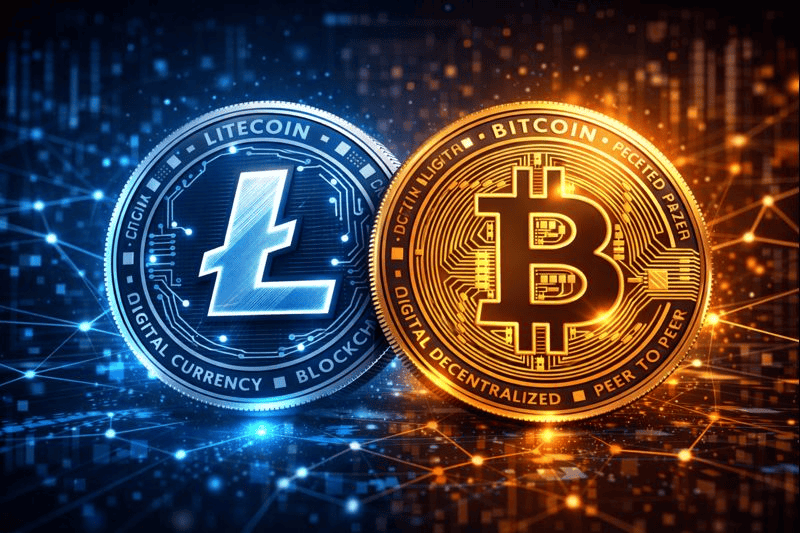
Litecoin was created in 2011 by Charlie Lee, a former Google engineer. His idea wasn’t to start from scratch but to improve on what already worked. He took Bitcoin’s code, adjusted key parameters, and released it as an experiment in efficiency and speed.
Over the years, it became known as a testing ground for new features. Technologies like Segregated Witness were adopted before making their way to Bitcoin, proving their stability in real-world conditions.
| Year | Event |
|---|---|
| 2011 | Litecoin launches |
| 2013 | Early exchange adoption |
| 2017 | SegWit implementation |
| 2021 | 10 years of continuous operation |
This long and stable history has helped LTC earn trust in a fast-changing industry.
Types of Litecoin
While Litecoin is a single cryptocurrency, it appears in different forms depending on how it’s used.
Native LTC
This is the standard version most people use. It’s sent between wallets, traded on exchanges, and accepted by merchants.
Wrapped LTC
Wrapped versions allow Litecoin to be used within decentralized finance platforms, making it compatible with smart contract systems.
Lightning-enabled LTC
It supports Lightning Network transactions, enabling near-instant payments for small amounts.
| Type | Purpose |
|---|---|
| Native LTC | Payments and transfers |
| Wrapped LTC | DeFi interaction |
| Lightning LTC | Instant microtransactions |
How does Litecoin work?
Litecoin operates on a decentralized network made up of thousands of computers, called nodes, spread across the world. When someone sends LTC from one wallet to another, the transaction is broadcast to this network rather than processed by a bank. Miners then verify the transaction using cryptographic rules and group it with others into a block. Once a block is confirmed, it is added permanently to the Litecoin blockchain, creating a transparent and tamper-resistant record that anyone can review.
To keep the network secure and fair, LTC uses a proof-of-work system based on the Scrypt algorithm. Miners compete to solve mathematical puzzles, and the first to succeed earns the right to add the next block and receive a reward. This process not only secures the network but also controls how it is introduced into circulation. With faster block times and lower fees than many alternatives, it is designed to feel practical and efficient for everyday digital payments rather than slow or complicated.
Pros & Cons
Before using, it’s helpful to look at both sides.
| Pros | Cons |
|---|---|
| Fast transaction speeds | Less media attention |
| Low fees | Smaller ecosystem |
| Proven reliability | Limited advanced features |
It prioritizes stability over spectacle, which appeals to some users more than others.
Uses of Litecoin
LTC isn’t just something people buy and forget about. It serves several practical purposes in the real world.
Digital Payments
LTC is accepted by various merchants for goods and services. Its low fees make it suitable for everyday spending.
Exchange Trading
Because Litecoin is widely listed, it plays a steady role in the Coin Market and is often used as a trading pair.
International Transfers
Sending money across borders with it can be faster and cheaper than traditional remittance methods.
Portfolio Diversification

Some users hold it alongside Bitcoin as part of a balanced crypto approach, especially when considering long-term Investment strategies.
These use cases show why Litecoin continues to matter even as newer projects emerge.
Resources
- Litecoin.org. Official Website.
- Litecoin.com. Learn About Litecoin.
- CoinMarketCap. Litecoin Price and Market Data.
- Coins.ph Academy. What Is LTC?.
- BitFlyer FAQ. Overview.