
When I first joined a mid-sized startup as a junior analyst, I thought my biggest challenge would be complex formulas or making sense of noisy datasets. Boy, was I wrong. The real monster in the room? Disorganized data scattered across dozens of systems, spreadsheets, and platforms. Every report felt like a scavenger hunt.
That’s when I met my game-changer: the data warehouse.
In today’s landscape of technology trends, the data warehouse is no longer a luxury; it’s the beating heart of informed decision-making. From fueling real-time dashboards to feeding machine learning models, it underpins the innovation powering tomorrow. In an age of iot devices churning out torrents of information, having a structured, central place for data isn’t optional—it’s essential.
What is Data Warehouse?
Let’s break it down in human-speak. A data warehouse is a centralized repository where information from different sources comes together. It’s like a digital library that stores, categorizes, and indexes data so it’s easy to retrieve, analyze, and act upon.
Synonyms and close cousins include data marts, enterprise data hubs, and data repositories. But none of them quite match the scalability and power of a true data warehouse.
In short? It’s where raw data goes to become useful insights.
Breaking Down Data Warehouse
Now, imagine trying to plan a road trip with a dozen maps—all in different formats, scales, and languages. That’s your business data without a data warehouse.
Here’s what makes a data warehouse tick:
- ETL Process (Extract, Transform, Load): It extracts data from various sources, transforms it into a common format, and loads it into the warehouse.
- Storage Layer: Structured tables optimized for querying and performance. Think of it as shelves in your digital library.
- Metadata: Describes the structure, origin, and usage of your data—like a table of contents.
- Query Engine: Allows users and tools to run reports, ask questions, and visualize trends.
Example: Netflix uses its data warehouse to track what you binge on Friday nights. That data helps them recommend your next guilty pleasure—or even greenlight new original content.
History of Data Warehouse
The journey of the database mirrors the evolution of digital transformation itself. From manual logs to real-time analytics, it’s been a wild ride.
| Year | Milestone |
|---|---|
| 1980s | IBM introduces early decision-support systems. |
| 1990 | Bill Inmon coins the term “Data Warehouse.” |
| 1996 | Ralph Kimball popularizes the dimensional modeling approach. |
| 2005 | Data warehouses begin moving to cloud platforms. |
| 2012 | Emergence of hybrid and real-time warehousing. |
| 2020+ | Rise of serverless and AI-driven data warehouses. |
From clunky on-premise systems to nimble cloud platforms, the data warehouse has evolved into a symbol of advanced technology.
Types of Data Warehouse
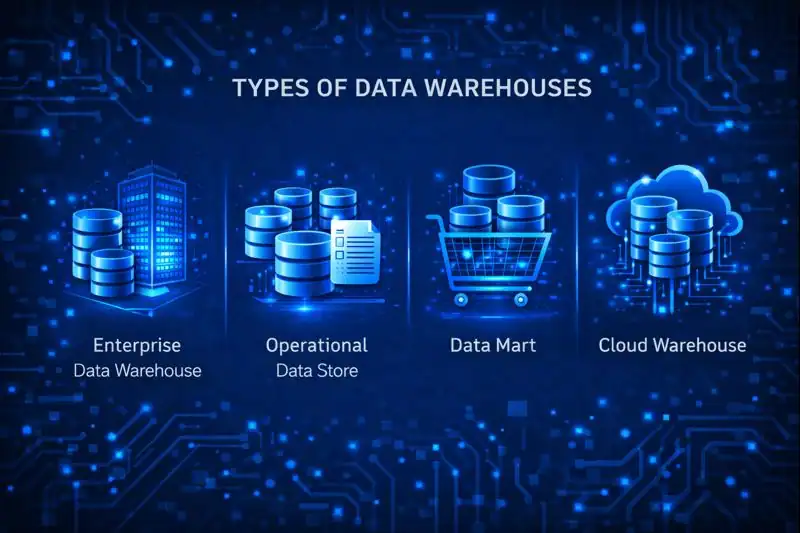
Not all data warehouses are created equal. Depending on your needs, budget, and tech stack, you’ll find several variations:
Enterprise Data Warehouse (EDW)
This is the granddaddy of them all—centralized, massive, and used company-wide.
Example: A multinational retailer uses an EDW to unify sales, inventory, and customer data from 30 countries.
Operational Data Store (ODS)
A near-real-time solution that supports daily operations rather than deep historical analysis.
Example: Banks use an ODS to track ATM transactions and balances in real time.
Data Mart
A smaller, subject-specific warehouse—ideal for departments like marketing or finance.
Example: A marketing team pulls customer segments from a dedicated data mart to design targeted campaigns.
Cloud
Scalable, flexible, and cost-effective. Popular with companies embracing futuristic technology.
Example: A startup uses Snowflake on AWS to scale their data infrastructure as they grow.
How Does Data Warehouse Work?

Understanding the inner workings of a data warehouse is like understanding the engine under the hood of a sports car—it’s what makes the magic happen.
- Data Collection: The system pulls data from diverse sources—CRM, ERP, spreadsheets, and APIs. Imagine vacuuming up information from every nook and cranny.
- Transformation: Data gets cleaned, formatted, and unified. Think of it as converting all ingredients to a common language before you start cooking.
- Loading: This formatted data is loaded into the warehouse and sorted into tables and schemas for fast retrieval.
- Querying: Now, users can run complex queries—like “Show me all customers in Texas who bought red shoes in Q3”—in seconds.
- Analysis & Visualization: Finally, the data powers dashboards, business intelligence tools, or machine learning models for predictive analytics.
Pros & Cons
Every superhero has a weakness, and every archive has its trade-offs.
| Pros | Cons |
|---|---|
| Centralizes all business data | Initial setup can be complex |
| Speeds up analytics and reporting | Can be costly without proper planning |
| Improves data accuracy and consistency | Requires skilled data engineers |
| Scales well with growing data | Ongoing maintenance needed |
| Supports data governance and compliance | Latency in real-time use cases |
Despite its drawbacks, it remains a cornerstone of digital transformation for good reason.
Uses of Data Warehouse
Whether you’re running a unicorn startup or managing a century-old enterprise, it can be your most powerful digital ally.
Business Intelligence
Most BI tools like Tableau or Power BI tap into data warehouses to serve up real-time dashboards and performance metrics.
Example: A telecom company uses it to visualize customer churn trends and plan retention strategies.
Predictive Analytics
By analyzing historical data, companies forecast future behavior, inventory needs, or financial trends.
Example: An e-commerce store predicts holiday sales using three years of shopping data stored in its data warehouse.
Compliance & Audit
In regulated industries like healthcare or finance, keeping historical records isn’t optional.
Example: A hospital group stores patient records securely to meet HIPAA compliance.
Customer Personalization
Imagine logging into an app and seeing recommendations tailored just for you. That’s the power of unified data.
Example: A streaming platform uses its to analyze your viewing habits and suggest your next binge.
Supply Chain Optimization
Companies use historical and real-time data to optimize logistics and reduce delivery times.
Example: A logistics company uses a data warehouse to reroute trucks during traffic spikes, reducing fuel costs.
Resources
Want to dig deeper into the world of data warehouse systems and strategies? Here are some high-quality reads:
- Google Cloud – Introduction to Data Warehousing
- Snowflake – What is a Data Warehouse?
- IBM – Data Warehousing Explained
- Gresham Tech – Modernize Data Platforms
- AWS – Data Warehousing on AWS